If you have moved house and found that your skin changed with the postcode, you were not imagining it. Water hardness varies enormously over short distances, and it does change how washing feels. But the effect is narrower than the filter market would like, and it is mostly not about minerals touching your face. It is about what those minerals do to your cleanser on the way down the drain.
Hardness, defined
Hard water is water carrying dissolved calcium and magnesium, picked up from the rock it has travelled through. Chalk and limestone dissolve readily. Granite barely dissolves at all. That is the whole mechanism, and it explains why a kettle in Kent furs up in a month while the same kettle in the Scottish Highlands can go years without a mark.
Hardness is measured as milligrams of calcium carbonate per litre, though several competing scales exist and your water supplier will publish a figure for your postcode. The line at which water starts being called hard sits somewhere between 120 and 180 milligrams per litre depending on whose scale you are reading. Below about 60, it is soft.
None of this is mysterious and none of it is new. What is new is the volume of marketing built on top of it.
The residue, not the minerals
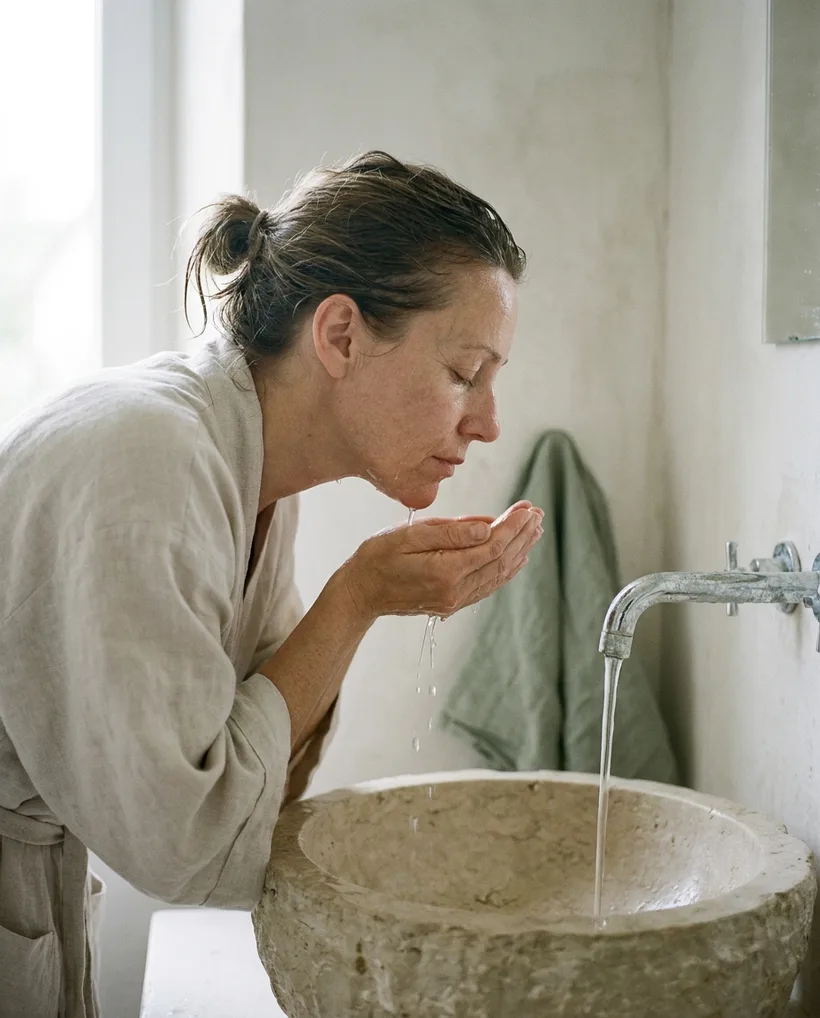
Calcium and magnesium ions react with the fatty acid salts in true soap to form compounds that will not dissolve. That is soap scum. The ring around the bath, the film on the shower screen, the dullness on a glass out of the dishwasher. The same reaction happens on your face. Part of the cleanser precipitates instead of rinsing, and it stays where it landed.
That residue is what most people are describing when they say hard water dries them out. It sits on the surface. It does not hold water the way a moisturiser does, and left there it can behave as a mild irritant. If you have wondered why your face feels tight in the minutes after washing, this is a large part of the answer, and it is the part nobody sells you a device for.
The minerals on their own are doing far less than they are given credit for. Calcium at domestic concentrations is not stripping your barrier. Where hard water does appear to make matters worse, it is in combination with a surfactant, which makes it a rinsing problem rather than a mineral-contact problem. The distinction matters, because the two point at completely different fixes.
The same cleanser in two cities
What you are feeling is the residue, not the minerals. Calcium and magnesium react with true soap to form compounds that will not dissolve, so part of the cleanser precipitates onto your face instead of rinsing away.
Take a bar of soap from a soft-water town to a hard-water one and it stops lathering properly. Same bar, same hands, different result. So you use more of it, and you rinse for longer, and you finish with more residue on your skin than you started out trying to remove. This is the practical form the problem takes, and it is why people conclude a product has been quietly reformulated when nothing has changed but the tap.
The intuitive geography, though, is wrong. London and Barcelona are both hard. London draws heavily on a chalk aquifer and sits at the very hard end of European supplies; Barcelona's water carries a different load, higher in chlorides and sulphates from the ground its rivers run through. Neither city is anywhere near soft. What differs between them is the character of the water rather than the presence of hardness, and then everything that happens to skin after the shower, which is a matter of humidity, sun and salt air rather than plumbing.
So when a cleanser that suited you in one place feels wrong in another, hardness is one variable among several and rarely the loudest. How hot you run the water, how long you stand under it, and what the air does to your skin for the following twelve hours are all competing for the same explanation.
Where the evidence stops
There is a substantial body of population research linking the hardness of domestic water to a higher prevalence of atopic skin conditions in young children. It has turned up in several countries with different climates and different health systems, which is the kind of consistency that deserves to be taken seriously rather than waved away.
What happened next is the part that rarely gets quoted. When water softeners were actually installed and tested against ordinary care, the improvement the association implied did not clearly appear. Reasonable people still disagree about why. The honest reading is that hardness may be one contributing exposure among many, and that softening the supply does not reliably undo it. Skin that is persistently cracked, itching or inflamed is a matter for a doctor, not for a shower fitting and not for a cream.
For an adult with no diagnosis and no unusual sensitivity, the effect of hard water is real, modest, and cosmetic in the literal sense of the word. It changes how skin looks and feels in the half hour after washing. That is a smaller claim than the one usually made, and it happens to be the true one.
The Skin Analysis
See your skin as we see it
Free. Sixteen questions, one photograph, and an address to send it to. A written assessment across eight markers, and the protocol that follows from it — no account, no payment, about four minutes.
Begin the free analysisWhat a shower filter can and cannot remove
Most shower filters contain a copper-zinc alloy medium, activated carbon, ascorbic acid, or some combination of the three. These are genuinely effective against chlorine, and chlorine is mildly drying, so people who notice a difference after fitting one are usually not imagining that either. If your supply is heavily chlorinated and you can smell it at the tap, a filter is a defensible small purchase.
What almost none of them do is soften water. Removing calcium and magnesium requires ion exchange: a resin bed that swaps the hardness ions for sodium and has to be regenerated periodically with salt. That is a plumbed appliance with a brine tank in a cupboard, not a cartridge screwed onto a shower arm. The small in-line cartridges sold as softeners do contain resin, but the volume of resin is tiny against the volume of a shower, and it exhausts far faster than the packaging implies.
So the honest summary is unglamorous. A shower filter may reduce chlorine, which some skins appreciate. It will not meaningfully change your water's hardness. A whole-house softener will, at the cost of installation, maintenance, salt and a small rise in the sodium content of the supply, and the strongest arguments for one concern your boiler and your kettle rather than your face.
What actually helps
Change the cleanser before you change the plumbing. True soap is the ingredient that reacts with hardness, so the swap that matters is away from soap and towards a synthetic detergent cleanser: the non-soap bars, and most gels, milks and creams. They do not form the same insoluble film, and they rinse out of hard water far more completely. It is a smaller intervention than a filter, it costs less, and it addresses the actual chemistry rather than the story around it.
Then the boring things, which are boring because they work. Cooler water. Less time under it. Fewer washes than instinct suggests, since the case for cleansing twice a day is thinner than most routines assume. And moisturise while the skin is still damp, before the residue and the evaporation have finished their work.
If you want a cheap diagnostic, wash your face once at the sink with bottled or filtered water and pay attention to the ten minutes that follow. It is not a controlled experiment and you should not treat it as one. But it will tell you, for the price of a bottle of water, whether the tap is a variable worth spending real money on.
A different question about water
We think about water more than most houses do, so it is worth being precise about which question we are answering. Our interest is in what a water carries: why we build the formulations on a specific mineral water rather than a purified blank, and how altitude and rock determine what a spring picks up on the way down. That is a question about composition inside a bottle, at a known quantity, in a known formula.
A tap is a different problem entirely. There the water is uncontrolled, it varies by postcode and by season, and most of its effect on your skin is mediated by whatever you dissolved into it thirty seconds earlier. Choosing a mineral water base is not a defence against your shower, and we would be overreaching to imply that it were. Different question, different answer.
The honest limit of this subject is that hard water is a small, real, largely rinse-related variable in how skin looks and feels. Get the cleanser right and it mostly stops mattering. If it does not stop mattering, the answer is probably not in the water.
Sources & References
- It is long-established basic chemistry that the calcium and magnesium ions responsible for water hardness react with fatty acid soaps to form insoluble salts, the film commonly known as soap scum, while synthetic detergents largely do not. Hardness of Water — U.S. Geological Survey Water Science School
- It is generally understood in hydrogeology that hardness reflects the rock a supply has passed through: chalk and limestone catchments yield hard water, granite catchments yield soft water. A randomised controlled trial of ion-exchange water softeners for the treatment of eczema in children
- A consistent body of population research has reported an association between domestic water hardness and a higher prevalence of atopic skin conditions in young children, while trials that actually installed softeners did not show a matching benefit. The question is generally regarded as unsettled. The Effect of Water Hardness on Surfactant Deposition after Washing and Subsequent Skin Irritation in Atopic Dermatiti
- It is well established that surfactant contact temporarily raises the pH of the skin surface and increases water loss through it, and that the effect is greater when washing is prolonged or the water is hot.
Related Reading



Explore Zero Lines
Maximise overnight repair with the Renewal and Repair Night Cream, formulated specifically to support your skin's circadian regeneration cycle.