
There is a particular feeling after washing your face. The skin across the cheekbones draws in. Smiling takes a fraction more effort than it did a minute ago. Most people read this as the cleanser having worked, and reach for a moisturiser to settle it down. It is worth sitting with a less flattering possibility: that the tightness is not evidence of clean skin at all, only evidence of what the cleanser took with it on the way out.
What the tightness actually is
The sensation is mechanical before it is anything else. Cleansing is done by surfactants, molecules with a water-loving end and an oil-loving end, which is what allows oil to leave your face in water that would otherwise refuse to carry it. They are effective. They are also not selective. They lift the day's sebum, sunscreen and city grime, and on the same pass they take a share of the lipids sitting between the cells of the outermost layer, and some of the small water-binding compounds held inside those cells.
What remains is a surface that holds water less well than it did ten minutes earlier. As it dries it contracts slightly, the way most thin materials do when they lose moisture, and because it is anchored to living tissue underneath it cannot contract freely. That restrained shrinkage is roughly what you are feeling. A physical event, occurring in the top fraction of a millimetre of you.
Which is also why it passes. Give it an hour and the feeling usually goes, as water moves up from the tissue below and the surface rehydrates itself. The sensation is real. It is simply a transient state of the outermost layer, and reading it as a verdict on how clean your face is confuses one thing for another entirely.
The pH your face is left at
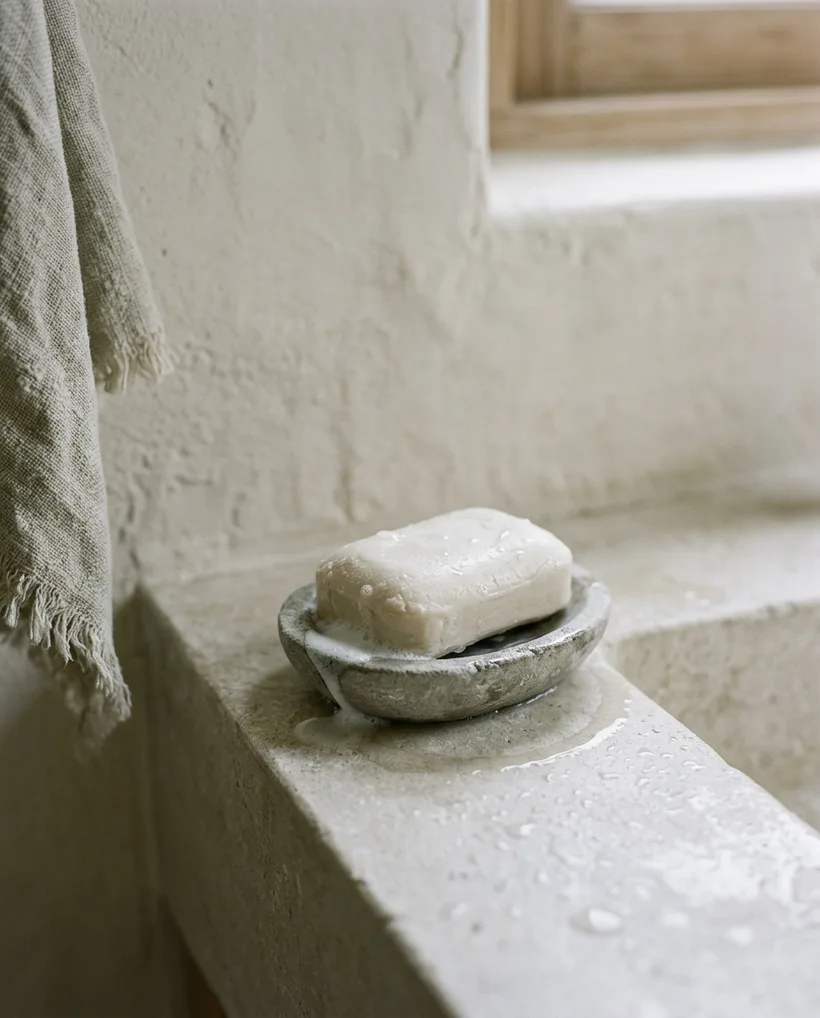
Skin's surface sits on the acid side of neutral, generally around pH 4.5 to 5.5. Traditional soap is strongly alkaline, and that is a consequence of how soap is made rather than a failing of any particular bar. Wash with it and the surface is pushed several points up the scale in the space of thirty seconds.
Skin brings itself back down on its own, over a few hours. But a good deal of the quiet housekeeping the surface does is tuned to that acidic range: the enzyme activity that lets spent cells detach in an orderly way, the processing of lipids into their organised arrangement. Push the pH up twice a day, every day, and the housekeeping is done in less favourable conditions than it was designed for.
The honest limit of this is that most of it has been characterised under laboratory conditions, and how much any individual face notices it varies enormously. Some people wash with a hard alkaline soap for forty years and are perfectly comfortable. Nobody can tell you which you are from a distance, including us. What can be said plainly is that a cleanser leaving you tight is a cleanser that has changed the state of your skin surface, and the tightness is the receipt.
Why the feeling is so convincing
We learned the squeak somewhere else. A plate that squeaks under a finger is clean, a strand of hair that squeaks is clean, and the association transfers to the face without anyone consciously deciding it should. The squeak is friction between two surfaces stripped of the film that was lubricating them. On a dinner plate that is exactly what you want.
Then there is the timing, which is the more interesting part. Skincare gives feedback on a scale of weeks, sometimes months, mostly in the form of you failing to notice anything and wondering whether you have wasted your money. A cleanser answers in eight seconds. It arrives with a physical sensation at precisely the moment you are looking for confirmation that the thing you just did was worth doing.
Immediate bodily sensations are far more persuasive than their information content justifies, and the industry has known this for a very long time. Foam volume, the cooling sting, the tingle, the squeak: these are sensory cues, they are inexpensive to formulate for, and they run more or less independently of whether a product suits your face. None of this makes a single tight evening harmful. It does mean the feeling is not telling you what you think it is telling you.
The moisturiser is often solving the cleanser
Watch the sequence. Skin goes tight. A cream goes on. Within half a minute the tightness is gone and the cream has demonstrated its worth. What the relief actually measures, though, is the size of the deficit that opened up two minutes earlier, at the sink.
This is why the question of what order to apply things in so often gets asked from the wrong end. People add a step, then another step, to close a gap that a different first step would not have opened. The routine grows. Each addition feels justified, because each one produces a noticeable improvement on the state the previous product left behind.
A cleanser that leaves the face comfortable changes what everything after it is for. The serum is no longer partly a repair job. The moisturiser is a choice rather than an obligation. And you find out what the rest of your routine is actually doing, which is information you cannot get while it is busy compensating.
The Skin Analysis
See your skin as we see it
Free. Sixteen questions, one photograph, and an address to send it to. A written assessment across eight markers, and the protocol that follows from it — no account, no payment, about four minutes.
Begin the free analysisA test you can run this week without buying anything
Wash your face at night exactly as you always do. Same product, same water temperature, same length of time. Pat dry rather than rub. Then apply nothing at all, and set a timer for ten minutes.
At ten minutes, pay attention. Not for a verdict, just for a description. Is the skin comfortable and unremarkable, the way the back of your forearm is unremarkable? Or is it drawn tight across the cheekbones, faintly itchy, papery around the mouth, stinging a little at the sides of the nose? There is no scoring system. You will know which one it is.
Run it five nights before you conclude anything, because one night is an anecdote. Sleep, a flight, a change in the weather and a hot shower all move the result. Skip the test on a night you have exfoliated, since the difference between exfoliating weekly and exfoliating daily shows up as tightness of its own and will confound the reading. Skip it after a razor pass too, for the same reason. If you are also weighing up whether to cleanse twice a day or once, hold that question until this one has an answer, or you will change two variables at once and learn nothing from either.
One caveat, and it matters. If the ten minutes is genuinely uncomfortable, if anything burns or stings properly, stop and put your moisturiser on. The test is not worth enduring. The answer in that case has already arrived.

What to read on the label if it fails
Ingredients appear in descending order of quantity down to one per cent, after which the order is the manufacturer's choice. So the first five or six names carry nearly all the meaning, and the long tail at the bottom carries almost none, whatever the front of the box has drawn your eye to.
Find the surfactant. Sodium lauryl sulphate and sodium laureth sulphate are the two most people have heard of, along with sodium C14-16 olefin sulphonate. On the pack they will be spelled the American way, sulfate, because ingredient names are standardised internationally regardless of where the product is sold. What matters is less whether they appear than where: second on the list is a different product from eighth.
Names like sodium palmate, sodium cocoate and sodium tallowate mean you are holding soap in the strict chemical sense, and soap is alkaline by definition. That is not a scandal. It is fine on many people's hands and bodies, and the face is a more demanding case. The gentler synthetic surfactants tend to have longer and less familiar names, among them cocamidopropyl betaine, sodium cocoyl isethionate and decyl glucoside. Their presence is a reasonable signal, not a promise; a formulation is a whole, and a mild surfactant can be undone by everything around it. Glycerin high on the list is generally a good sign.
Two things to read nothing into. Foam is one. Lather can be tuned almost independently of how stripping a blend is, so a cleanser that barely bubbles may be considerably harsher than one that fills your hands. The phrase pH balanced is the other, since it has no fixed legal meaning and no number attached. And be wary of choosing by the category printed on the front, because a fair amount of what people have filed under their own skin type turns out to be a cleanser they have been using without questioning it since they were nineteen.
Where this stops being about cleansers
If the tightness does not fade within an hour or two, or if skin is flaking, cracking, persistently sore or visibly inflamed, this article has run out of usefulness. That pattern is worth a doctor looking at it rather than a label. Several conditions present that way, none of them are a cleanser's business to sort out, and swapping products is at best a delay.
For everyone else the conclusion is smaller and duller than the internet would like it to be. A cleanser cannot transform anything. The most a well-made one can do is remove what was on your face and leave the skin looking and feeling roughly as it did before you started, which is an unglamorous bar and one that a surprising number of them fail to clear. We would rather say that than describe a rinse-off product as though it were a treatment.
So the test is the point, not the shopping. Ten minutes, five nights, nothing bought. Whatever your face tells you at the end of it is more useful than anything printed on a carton, including ours.
Sources & References
- It is long and uncontroversially established that the surface of healthy skin sits on the acid side of neutral, in the region of pH 4.5 to 5.5, and that true soaps are strongly alkaline by comparison. Natural skin surface pH is on average below 5, which is beneficial for its resident flora
- The general finding that surfactants remove sebum along with some of the lipids and water-binding compounds of the outermost skin layer, and that water loss from the surface rises measurably after washing with harsher cleansers, is standard textbook skin chemistry rather than a novel result. Drying stress and damage processes in human stratum corneum
- It is widely understood in skin biophysics that the outermost layer becomes stiffer and contracts slightly as it dries, which is the accepted mechanical explanation for the sensation of tightness. Glycerol and the skin: holistic approach to its origin and functions
- Glycerin's behaviour as a humectant, drawing and holding water at the skin surface, has an unusually long and undisputed record and is not in serious scientific contention.
Related Reading




Explore Zero Lines
Maximise overnight repair with the Renewal and Repair Night Cream, formulated specifically to support your skin's circadian regeneration cycle.