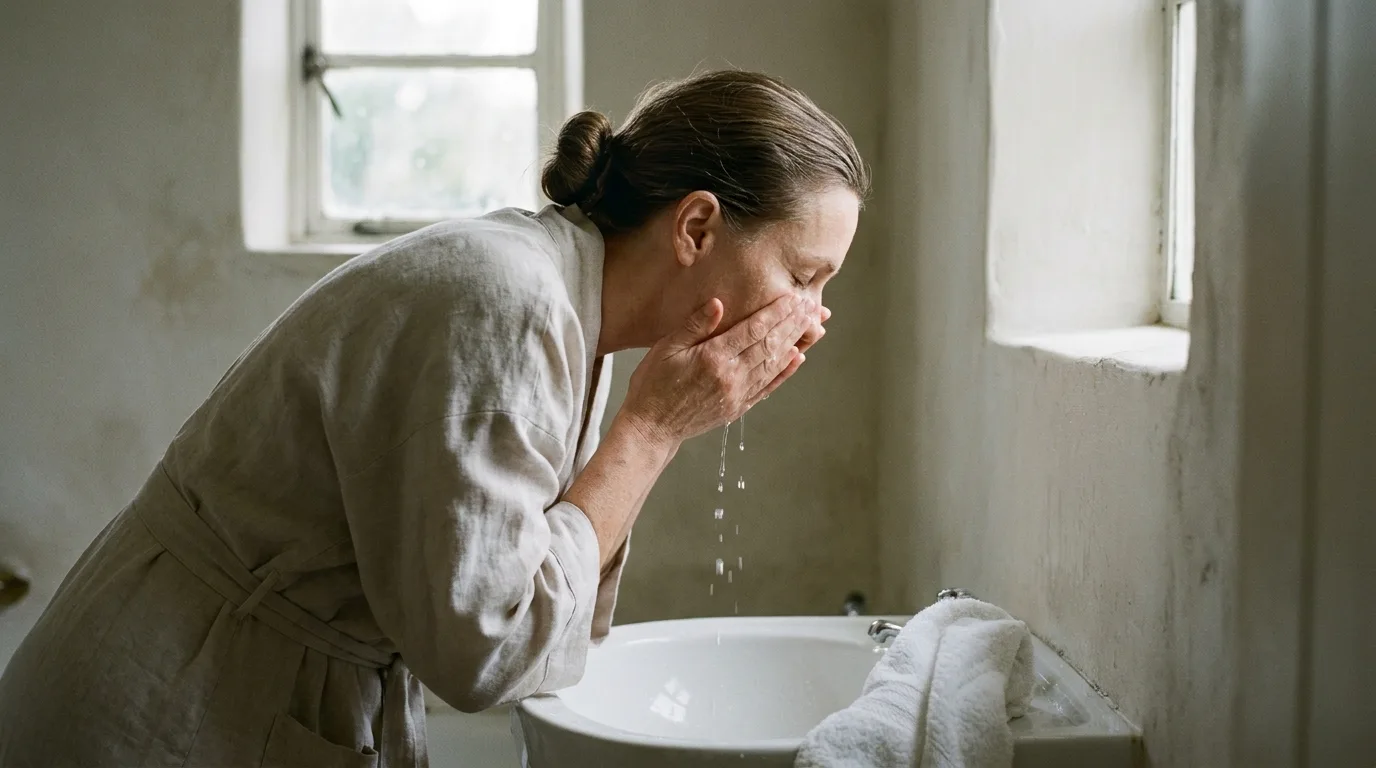
Ten pieces in this journal open by telling you to start with a gentle cleanser. Not one of them says what gentle means. And the six-step protocol we describe elsewhere contains no cleanser at all, which makes the omission slightly worse than careless. So: this is the article about washing your face. It is mostly about what washing does not do, and about the one question that genuinely has two answers.
The step we kept assuming
We went back through the archive to check. The phrase "start with a gentle cleanser" opens ten articles here, where it functions as an establishing shot — the sentence you write to get to the interesting part. Meanwhile the six formulations we sequence into a protocol begin at exfoliation. There is no wash in it. That is not a gap in the writing so much as a gap in the thinking.
It happens for a dull reason. Cleansing is the least commercially interesting step in skincare. Nobody builds a house on it, and it is difficult to say anything about a rinse-off product that sounds like news. So it becomes throat-clearing before the actives arrive.
The awkward part is that for most people the wash is the step with the most room to go wrong. A serum that underperforms costs you an outcome you were never certain of. A wash that strips the skin every night and every morning makes everything applied afterwards feel worse, and it does so quietly, over months, while you blame the serum.
What a wash is actually for
Three things come off a face. Sunscreen. Sebum, along with whatever it has picked up and whatever it has turned into over the course of a day. And the ordinary deposits of being out in the world — road particulate, cooking grease, dust, whatever your hands transferred. That is the list. It is shorter than the category implies.
What a wash is not for is deep cleaning, because there is no depth available to it. The outer layer of skin is a barrier whose entire function is to keep things out, and nothing you apply to the surface crosses it in any quantity worth discussing. A cleanser sits on the top few micrometres for forty seconds and then goes down the sink. It does not detoxify anything. Pores do not open in warm water and close in cold — they have no muscle to do it with. What changes is how soft the sebum inside them has become, which is useful, and which is not the same claim at all.
This is a relief rather than a disappointment. It means washing is a small mechanical task with a low ceiling. You can do it well; you cannot do it brilliantly. There is no cleanser that will change your face. There are cleansers that leave the skin in a better state to be worked on than others, and that is the whole of the competition.
The evening wash, which is close to non-negotiable

If you wear sunscreen daily — and this journal takes the position that you should — the evening wash follows from it. Modern SPF films are engineered to stay on through heat, sweat and swimming. That resistance is the point of them, and it is also the reason water alone will not take one off. You need a surfactant, which is to say you need a cleanser, which is why the evening question closes itself.
Sebum makes the second half of the argument. It is mostly triglycerides, wax esters and squalene, and squalene oxidises readily on a warm surface in daylight, so the film on your face at eight in the evening is not chemically what your skin secreted at eight in the morning. Sleeping in it is not a catastrophe. It is untidy, and it sits between your skin and whatever comes next — the order in which everything else goes on quietly assumes a clean, slightly damp surface underneath.
The technique is not complicated enough to justify a section, so here it is in a sentence. Lukewarm water, a cleanser that suits you, thirty to sixty seconds, rinse until the skin stops feeling slippery, then pat dry rather than rub. That is the entire method. It has been sold to you at considerably greater length.
The morning is a real question
Three things come off a face: sunscreen, sebum, and the ordinary deposits of being out in the world. There is no depth to clean — a cleanser sits on the top few micrometres for forty seconds and then goes down the sink.
Overnight, your face meets a pillowcase and its own oil. That is the whole exposure. If you washed properly the night before, there is a perfectly good argument that you wake up with a clean face, and that washing it again removes lipids the skin spent hours rebuilding, in exchange for nothing.
There is an equally good argument on the other side, and it is not weaker. Some people produce a great deal of sebum overnight. Some apply a rich night cream or a balm that is still sitting there at seven in the morning. Some sleep warm, or sleep in a warm climate, and wake up damp. Some are about to apply a sunscreen that will sit badly on top of last night's residue and pill by ten. For all of them the morning wash is preparation rather than habit. The two ends of the day have different jobs, and the morning's job is to get the skin ready to be protected.
The honest position is that this question has a personal answer, and that anybody handing you a universal rule is handing you their own skin's answer with the labelling removed.
The Skin Analysis
See your skin as we see it
Free. Sixteen questions, one photograph, and an address to send it to. A written assessment across eight markers, and the protocol that follows from it — no account, no payment, about four minutes.
Begin the free analysisA way to decide instead of a rule to obey
Try it as a test rather than a belief. For one week, in the mornings, rinse with lukewarm water and your hands and nothing else, then continue with the rest of your routine exactly as before. Same products, same order, same evening wash. One variable, one week: long enough for a pattern to show, short enough that you will finish it.
Then ask what you noticed. Does the skin feel coated by mid-morning, or does it feel like skin? Does sunscreen go on evenly, or does it slide and pill where it did not before? And the thing people forget to check: how does the face look at six in the evening, when any difference in oil will have declared itself.
Comfortable skin, sunscreen sitting flat, nothing worse at the end of the day — you did not need the morning wash, and you can stop. Shine by nine, pilling, a rougher-looking surface — you do, and that is settled too. Neither answer makes you more or less serious about your skin. It is sebum, and sebum varies enormously between people, and between seasons.
One caveat worth stating plainly. If your skin already feels tight and squeaky after washing, do not run this experiment yet. That tightness means the wash you own is taking more than it needs to, and until you fix the product, changing the frequency only changes how often the problem happens.

Double cleansing, kept in proportion
The practice is straightforward and the chemistry behind it is sound. An oil or balm goes on first and dissolves the oil-soluble things — sunscreen, long-wear makeup, sebum — because like dissolves like. A water-based wash follows and carries away the oil along with everything now suspended in it. It came out of routines where people wore substantial sunscreen and substantial makeup every day, and in that context it does something a single mild gel often cannot.
So the question is not whether double cleansing works. It is whether you are the person it was designed for. If you wear a high-SPF film daily, or long-wear base, or both, one pass frequently leaves residue — you can verify this yourself with a cotton pad after your usual wash, which is a more useful piece of evidence than anything we could tell you.
If you wear nothing but your own sebum, two washes is one wash too many, and the second is where the tightness comes from. Double cleansing is a technique matched to a load, not a level of commitment. Nobody is grading you on it.
What gentle means, and why we can afford to say
Since we have used the word ten times without defining it: gentle is mostly a question of the surfactant system, the part of the formula doing the actual work and rarely the part named on the front of the bottle. Milder blends behave better than the harsher sulphates common in older formulations. Foam is not evidence of cleaning; it is evidence of foaming agents, and the two are only loosely related. A wash formulated near the skin's own mildly acidic surface is easier on it than a strongly alkaline bar. The rest of the test is subjective and reliable: after rinsing and patting dry, your face should feel unremarkable. Not tight, not squeaky, not still coated.
Water is the variable nobody mentions. The same cleanser genuinely behaves differently in two cities, because the mineral content of what comes out of your tap changes how surfactants rinse and what they leave behind. If a product that suited you for years turned harsh after you moved, that is a plausible explanation and worth testing before you blame your skin.
One boundary, stated once. Skin that is persistently sore, inflamed or breaking out in a way that affects how you live is not a cleansing problem, and no wash is the answer to it. Those are matters for a doctor, and choosing a different face wash while waiting for an appointment is a way of doing something rather than a way of treating anything.
Now the disclosure that makes this article possible. Zero Lines does not make a cleanser. There are six formulations and none of them is a wash, and there is no plan to attach one to the end of this piece. So we have nothing to steer you towards, and can say the useful thing instead: keep the cleanser you have if it leaves your face comfortable, and replace it with the mildest inexpensive one at your pharmacy if it does not. That is what those ten articles should have said. Start with a wash that leaves your skin feeling like nothing much happened, then get on with the parts worth arguing about.
Sources & References
- That the intact outer layer of skin acts as a barrier is among the least controversial ideas in dermatology. The general understanding is that molecules much above a few hundred daltons do not cross it in meaningful amounts, which is why nothing rinsed off the surface can reach anything beneath it. The 500 Dalton rule for the skin penetration of chemical compounds and drugs (Bos JD, Meinardi MM. Exp Dermatol. 2000;
- It is well established in cosmetic science that surfactants remove skin lipids along with oil and soil, that harsher ones remove more, and that water loss through the skin rises temporarily after washing before recovering. Cleansing without compromise: the impact of cleansers on the skin barrier and the technology of mild cleansing (Ananth
- Healthy skin surface is generally understood to be mildly acidic, usually described as sitting somewhere between pH 4.5 and 5.5. Alkaline washing raises it temporarily, with recovery normally measured in hours. Sebaceous gland lipids (Picardo M, Ottaviani M, Camera E, Mastrofrancesco A. Dermatoendocrinol. 2009;1(2):68-71)
- The broad composition of sebum — triglycerides, wax esters and squalene — and the readiness with which squalene oxidises on the skin surface are both long-standing findings rather than recent ones.
Related Reading




Explore Zero Lines
Maximise overnight repair with the Renewal and Repair Night Cream, formulated specifically to support your skin's circadian regeneration cycle.