
Your skin doesn't operate on the same schedule around the clock. Like every other organ, it follows a circadian rhythm — a 24-hour cycle of activity and repair governed by light exposure, hormone fluctuations, and cellular metabolism. Understanding this rhythm is the key to building routines that actually work.
The Skin's Daily Cycle
Research published in the International Journal of Molecular Sciences mapped the skin's circadian gene expression in detail. Here's what happens:
Morning (6 AM – 12 PM): Skin transitions from repair mode to defence mode. Sebum production increases. The barrier thickens. Blood flow rises. Your skin is preparing to face the day — pollution, UV, temperature changes, and makeup.
Afternoon (12 PM – 6 PM): Peak sebum production. Skin is at its most oily and most protected. This is when makeup breaks down and shine appears.
Evening (6 PM – 12 AM): Skin begins shifting back to repair mode. Blood flow increases to support nutrient delivery. The barrier becomes more permeable — meaning products penetrate more effectively.
Night (12 AM – 6 AM): Peak repair mode. Cellular turnover is up to 30 times faster than during the day. Growth hormone peaks around 2 AM. This is when the skin does its most important rebuilding work.
What Your Morning Routine Should Do

Morning skincare has one primary objective: protect. Your skin is about to face UV radiation, pollution, temperature fluctuations, and potentially makeup. It needs:
- Antioxidant defence: Neutralising free radicals before they can damage cellular DNA. Vitamin C is the gold standard.
- UV protection: Non-negotiable. SPF 30+ broad spectrum, every single morning.
- Barrier support: A light moisturiser that maintains hydration without heaviness.
- Light hydration: Your skin is naturally more hydrated in the morning due to overnight repair processes.
The Zero Lines morning sequence:
- Cleanse (optional — many people do fine with water)
- Bio-Signal Face Serum — lightweight hydration and antioxidant support
- Precision Collagen Renewal Line Corrector — peptide signalling
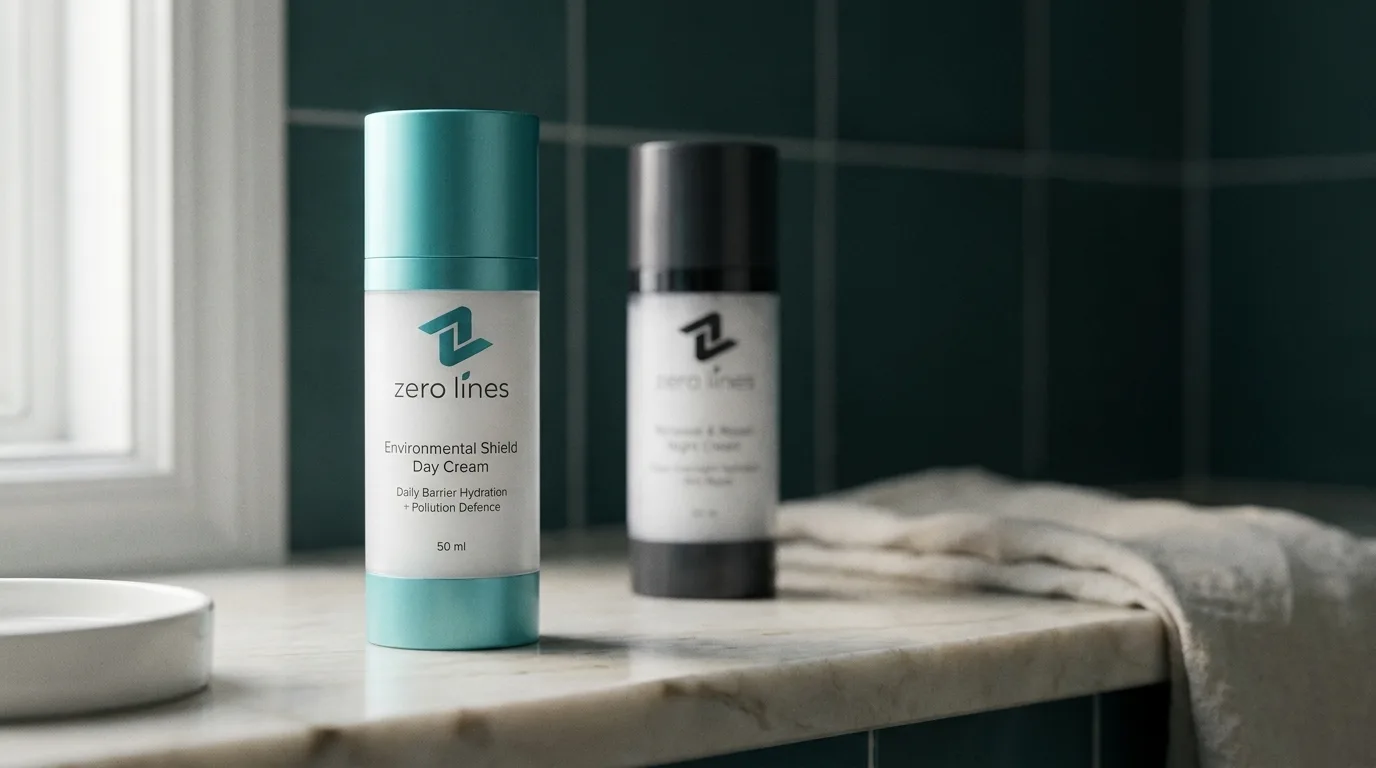
- Environmental Shield Day Cream — environmental defence and barrier support, worn under your SPF
What Your Night Routine Should Do
Skin runs on a circadian rhythm. Mornings are defence — sebum rising, barrier thicker, blood flow up. Nights are repair, with cell turnover and growth hormone peaking in the small hours.
Night skincare has a different objective: repair. Your skin is in its most receptive state. Blood flow is up. Cellular turnover is accelerating. Products penetrate more deeply. This is when you use the heavy hitters:
- Retinoids or peptides: Cell-signalling ingredients that stimulate collagen and accelerate turnover.
- Rich moisturisation: Supporting the barrier with lipids and occlusives that prevent water loss during peak repair.
- Exfoliation: 1–2x weekly, chemical exfoliation removes dead cells so repair ingredients can reach living tissue.
- Recovery support: Ingredients like niacinamide that reduce inflammation and support the repair process.
The Zero Lines evening sequence:
- Cleanse thoroughly
- Bio-Renewal Peeling Gel — 1–2x weekly only
- Bio-Signal Face Serum
- Precision Collagen Renewal Line Corrector or Refill
- Renewal and Repair Night Cream — rich, occlusive, supportive
Ingredients That Belong at Night
Some ingredients are photolabile, which means they break down in sunlight. Others are photosensitising: they make skin more reactive to UV. Both belong exclusively in your night routine:
- Retinoids: Break down in UV light and increase photosensitivity. Always night-only.
- AHAs/BHAs: Increase photosensitivity for 24–48 hours after use. Best at night.
- Certain peptides: Some are unstable in daylight. Our botanical peptides are stable, but many synthetic versions aren't.
- Rich oils and balms: Can feel heavy under makeup and don't provide daytime benefits.
Ingredients That Belong in the Morning
Conversely, some ingredients work best when skin is in defence mode:
- Vitamin C: Works synergistically with sunscreen to boost UV protection. Unstable in some formulations, so morning use ensures freshness.
- Mineral sunscreen: Physical UV blockers that work immediately upon application. Essential for daytime.
- Antioxidants: Pre-emptive defence against the free radicals you'll encounter during the day.
The Case for Different Products
You could use the same moisturiser morning and night. But you'd be missing an opportunity. Day cream should be light, protective, and compatible with makeup and sunscreen. Night cream should be rich, reparative, and occlusive enough to prevent water loss during peak repair hours.
Our Environmental Shield Day Cream and Renewal and Repair Night Cream were formulated specifically for these different roles. The Day Cream is an emulsion — water and oil combined in a light, breathable texture. The Night Cream is richer, with more lipids and a higher concentration of repair-focused actives. Same brand, same philosophy, different jobs.
The Circadian Rhythm of Skin
Your skin doesn't behave the same way at 8 AM as it does at 10 PM. It follows a circadian rhythm — an internal clock that regulates cellular processes on a roughly 24-hour cycle. Knowing how that clock runs tells you when each ingredient does its best work.
In the morning, skin is in defence mode. Sebum production peaks around midday. Skin thickness is at its maximum. Blood flow is higher. The priority is protection — from UV, pollution, and environmental stressors. This is when antioxidants and SPF deliver their highest return.
At night, skin switches to repair mode. Cell division peaks between 11 PM and 2 AM. Blood flow increases, delivering nutrients and removing waste. Trans-epidermal water loss is highest, meaning skin is most receptive to hydration. This is when reparative ingredients — peptides, retinoids, growth factors — work most effectively.
Ingredients That Work Best at Night
Retinoids are inherently photosensitising — they increase skin's sensitivity to UV and can degrade when exposed to sunlight. Peptides signal cellular repair, which aligns with the skin's nighttime regeneration cycle. Richer moisturisers with ceramides and lipids support barrier repair when the skin is most permeable.
Our Renewal and Repair Night Cream is formulated specifically for the nighttime window. It contains signal peptides, ceramides, and a higher concentration of nourishing lipids than our day cream — designed to support the repair processes that peak while you sleep.
"The best morning routine protects. The best evening routine repairs. Get either wrong, and you're fighting your skin's natural biology instead of working with it."
— Zero Lines Formulation Team
Get Your AM/PM Protocol
The skin analysis builds separate morning and evening routines based on your skin's circadian needs, climate, and concerns.
Build My RoutinesRelated Reading



The Skin Analysis
See your skin as we see it
Free. Sixteen questions, one photograph, and an address to send it to. A written assessment across eight markers, and the protocol that follows from it — no account, no payment, about four minutes.
Begin the free analysis
Explore Zero Lines
Build both routines with the Bio-Signal Face Serum and Environmental Shield Day Cream for morning, plus the Renewal and Repair Night Cream for evening.