
It arrives without warning, though it was never sudden. One morning the serum you have used for a year goes on and your cheeks light up. Not a rash, not a burn. Just a bright, unfriendly sting that fades in a minute and leaves you standing at the sink wondering what you did. Then the moisturiser does it too. Then plain water. Nothing in your routine changed, which is precisely the problem.
What the barrier actually is
The outermost layer of your skin is roughly as thick as clingfilm. It is made of flattened cells that are no longer alive, stacked in overlapping sheets and held together by a mixture of fats — ceramides, cholesterol, fatty acids. Bricks and mortar is the usual comparison and it is a decent one. The job of this layer is unglamorous: keep water in, keep most of the outside world out.
When people say the barrier is compromised, what they mean is that the mortar has gone thin and patchy in places. Water leaves faster than it should. Things that were meant to stay on the surface get slightly further in than they were designed to, and the nerve endings below get more of the message than they would otherwise. That is the sting. It is not the product doing something new. It is the same product arriving somewhere it did not used to reach.
The honest limit of this is that you cannot see any of it. The barrier is a model — a useful, well-supported model, but not a thing you can inspect in the bathroom mirror. What you actually have is a pattern: a sensation that was not there before, and a look that has shifted. Skin that has been through this tends to look flushed rather than evenly pink, and shiny in a thin, papery way rather than dewy. One stinging morning is not evidence of anything. Three weeks of them is.
The causes are cumulative and dull
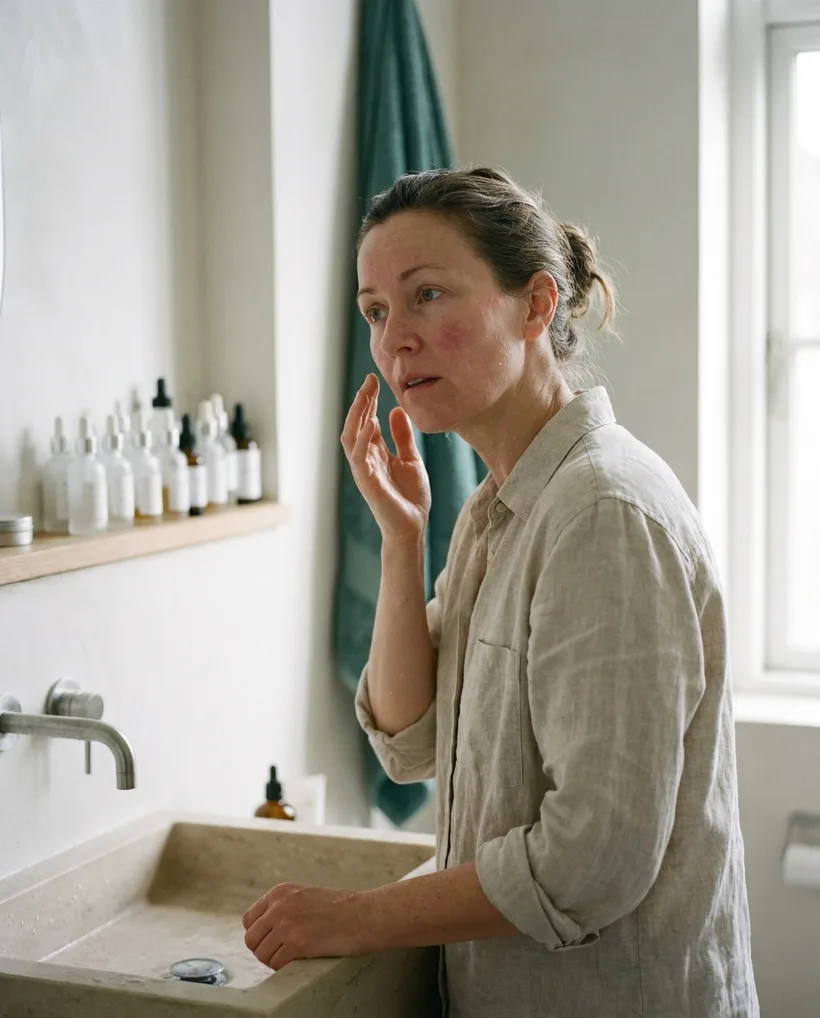
Almost everyone looks for a culprit. A new bottle, a bad batch, something that arrived in the post last Tuesday. Usually there isn't one. What there is, instead, is arithmetic. An acid twice a week. A retinoid three nights. Vitamin C every morning. A clay mask on Sundays because Sunday feels like the day for it. Each of those is defensible on its own, and taken together they leave the skin no days off at all. The damage is not dramatic; it is a slow overdraft.
Then there is the cleanser, which is almost never suspected, because it is on your face for forty seconds and then it is gone. But it is the only product in the routine whose entire purpose is to remove things, and you use it twice a day, every day, for years. If yours leaves you with that tight, squeaky feeling once the water is off, it has been taking slightly more than it should the whole time. Nobody notices, because it never stings. It just quietly raises the floor of everything else.
Non-product life contributes too, and gets less credit than it deserves. A winter of dry indoor heating. Showers hot enough to redden the face. A fortnight of bad sleep, a long flight, a new prescription from your GP. Skin is a record of the last month rather than the last night, which is why the timing never seems to line up with anything you can name.
How this differs from ordinary dryness
The outermost layer is about as thick as clingfilm: dead flattened cells held in a mortar of ceramides, cholesterol and fatty acids. When that mortar thins, things reach nerve endings they used not to. That is the sting.
Dry skin wants moisturiser and is grateful when it gets it. That is the whole test, really. If a plain cream goes on and things immediately feel better, you are dry. If a plain cream goes on and your face objects for thirty seconds first, something else is happening. The distinguishing feature here is not dryness. It is reactivity — the skin has stopped being able to tell the difference between an ingredient and an insult.
The look changes in ways that are easier to notice on photographs than in the mirror. Foundation that used to sit flat starts clinging to small rough patches by midday. Fine lines around the eyes and across the forehead look more obvious than they did in the spring, because skin holding less water creases more readily and holds the crease longer. Colour concentrates around the nose and the inner cheeks. None of this is permanent, and none of it means the underlying structure has changed. It means the surface is not holding water well.
One more clue: it is usually worst exactly where you have been most diligent. The cheeks, which get the serum. The area around the nose, which gets the extra pass with the cleanser. Not the neck, which gets whatever is left on your hands.
The smallest possible routine, for two weeks
The recovery is subtraction, and it is genuinely boring. Everything with an active in it goes in a drawer — not the bin, a drawer, you will want most of it back later. Acids, retinoids, vitamin C, enzymes, scrubs, peels, masks, anything that describes itself as resurfacing or brightening. Not reduced in frequency. Stopped. Two weeks is the usual minimum and some people need four.
What remains is three things at most. Lukewarm water in the morning and nothing else. At night, one bland cleanser without fragrance, applied with your hands rather than a cloth or a brush. One plain moisturiser, put on while the skin is still slightly damp. Sunscreen if you will be outside, and if your usual one stings, a mineral filter is often easier to tolerate for a while — often, not always, and if it also stings then a hat is a perfectly respectable answer for a fortnight.
A pleasant side effect is that the questions get simpler. The order you put things on matters a great deal when there are six of them and hardly at all when there are two. There is nothing to sequence, nothing to wait between, nothing to decide at eleven at night.
People find this difficult, and the difficulty is not physical. It feels like doing nothing, and doing nothing feels like giving up on your face. But the skin renews its own surface layer continuously and repairs the lipid mortar on its own schedule; it simply cannot do that while being interrupted twice a day. The deliberate nothing is the active step. Everything else is just staying out of the way.
The Skin Analysis
See your skin as we see it
Free. Sixteen questions, one photograph, and an address to send it to. A written assessment across eight markers, and the protocol that follows from it — no account, no payment, about four minutes.
Begin the free analysis
Putting things back, one at a time
Start reintroducing when the stinging has been gone for about a week, not on the first comfortable morning. One product. Then two weeks of that product alone before the next one goes back. Yes, this means a full routine takes a couple of months to reassemble. That is the cost of knowing which thing was the problem, and it is a much better deal than doing the whole cycle again next winter.
Order matters less than restraint, but the sensible sequence is the useful and gentle first: sunscreen, if you dropped it, then one active. One. Whichever of them you would keep if you could only keep a single bottle. Vitamin C and an acid in the same fortnight tells you nothing about either.
Retinoids deserve their own patience, because they are the most common single cause of the whole episode and the most worthwhile thing to get right. Going back to retinol slowly means twice a week, at night, on dry skin, over moisturiser rather than under it, for longer than feels necessary. If it stings on reintroduction, you have gone too fast, not found your limit.
Write the dates down. A note on your phone with a product name and a date is unremarkable advice and almost nobody follows it, and then six weeks later nobody can remember what they added when. Expect the arc to be slow either way — a new routine needs about a month before you can say anything sensible about it, and a recovering one needs the same courtesy.
When this is not a skincare problem
A good share of the people searching for how to repair a damaged barrier do not have a damaged barrier. There are several common skin conditions that present as sensitivity and stinging, have proper names, and have treatments that no cleanser will ever substitute for. Diagnosing yourself from search results is a poor idea, and treating a genuine condition with a gentler routine mostly wastes the months in which something would have helped. That is a matter for a GP or a dermatologist.
Some things should send you to one sooner rather than later. If it appeared over a day or two rather than creeping up over months. If there is swelling, blistering, weeping or crusting. If it is spreading beyond the face, or has a sharp border you could trace with a finger. If it itches considerably more than it stings. If it hurts. If you started any new medication, oral or topical, in the preceding weeks. And if a month of the minimal routine above has changed nothing at all — that flat lack of response is itself information.
Worth knowing: if you react to a great many products and cannot work out the pattern, patch testing exists. A clinician applies small amounts of specific substances under a dressing and reads the result over several days. It is the only reliable way to find out what you are actually reacting to, and it is a great deal cheaper than another year of buying and discarding bottles.
The honest limits of all this
No product repairs a barrier. Skin does that itself, and the most a formulation can do is hold water at the surface and refrain from making things worse while the work happens. When a label says barrier repair, it is describing an intention rather than an event. That is not a scandal — the intention is a reasonable one — but the sentence is doing more work than the cream is.
Timelines vary and we cannot tell you yours. Some people are comfortable inside ten days. Some take two months and there is no obvious reason for the difference; age, climate, how long the overuse ran and how hard it ran all seem to matter, and none of them predicts an individual reliably. Anyone offering you a number is guessing with confidence.
We make six formulations and none of them is on sale. We would rather say plainly that if your face is stinging this week, the thing that will fix it costs almost nothing and consists mostly of refusal: a bland cleanser, a plain moisturiser, two weeks of patience and the discipline not to reach for something new. Buy that from a pharmacy. It is the least profitable advice in skincare and the closest thing the category has to a reliable outcome.
Sources & References
- The outermost layer of skin is generally understood to consist of flattened, non-living cells embedded in a matrix of lipids — chiefly ceramides, cholesterol and free fatty acids. This is the standard textbook description of the stratum corneum. The role of ceramides in the disruption of the cutaneous permeability barrier, a common manifestation of skin disorder
- Transepidermal water loss, the rate at which water evaporates outward through the skin, is the measure commonly used in research to describe how well that outer layer is performing, and it is well established that it rises when the layer is disrupted. Cleansing without compromise: the impact of cleansers on the skin barrier and the technology of mild cleansing (Ananth
- It is widely accepted that the skin surface is mildly acidic, and that surfactants used in cleansers can remove surface lipids and temporarily shift that surface pH — the reason cleanser choice and frequency matter more than their brief contact time suggests. Patch Testing — patient information leaflet, British Association of Dermatologists
- Patch testing is the established clinical method for identifying contact reactions to specific substances. It is carried out and interpreted by clinicians over several days, not at home.
Related Reading




Explore Zero Lines
Maximise overnight repair with the Renewal and Repair Night Cream, formulated specifically to support your skin's circadian regeneration cycle.