
Science
The Complete Guide to Skin Aging: What Actually Happens After 30
Somewhere around your thirtieth birthday, your skin quietly shifts gears. The changes are subtle at first — a fine line that doesn't smooth out by morning, a slight dullness that persists even after a good night's sleep. Most people attribute these early signs to stress, late nights, or simply getting older. But what's actually happening is far more specific — and far more actionable.
At Zero Lines, we spent four years studying these mechanisms not to scare anyone, but to build a protocol that addresses each one systematically. This guide explains what we learned.
The Four Mechanisms of Skin Ageing
Skin ageing is not one process. It's four distinct biological mechanisms that run in parallel, each compounding the others:
- Collagen degradation — The structural scaffold beneath your skin thins and fragments.
- Cellular senescence — Damaged cells stop dividing but refuse to die, releasing inflammatory signals that harm neighbouring cells.
- Barrier dysfunction — The outermost layer loses lipids and integrity, leading to chronic dehydration and sensitivity.
- Melanin dysregulation — Pigment production becomes uneven, creating dark spots and patchy tone.
Most skincare products target only one of these. A moisturiser might help the barrier. A vitamin C serum might help pigmentation. But without addressing all four in a coordinated way, you're playing whack-a-mole with symptoms while the underlying biology continues its decline.
Collagen Loss: The 1% Rule
After age 30, most people lose approximately 1% of their dermal collagen per year. That doesn't sound catastrophic until you do the maths: by 50, you've lost roughly 20% of the structural protein that keeps your skin firm and smooth.
But the loss isn't just quantitative. The collagen that remains becomes disorganised — like a well-tended garden slowly turning into a tangle of weeds. Fibroblasts, the cells that produce collagen, become less responsive to the signals that tell them to rebuild. The result is skin that not only has less collagen, but also collagen arranged in a way that provides less structural support.
This is why simply applying collagen to the surface rarely helps. The molecule is too large to penetrate, and even if it could, it wouldn't restore the organisation of the existing matrix. What works is signalling — sending molecules small enough to reach the fibroblasts and remind them what they're supposed to do.
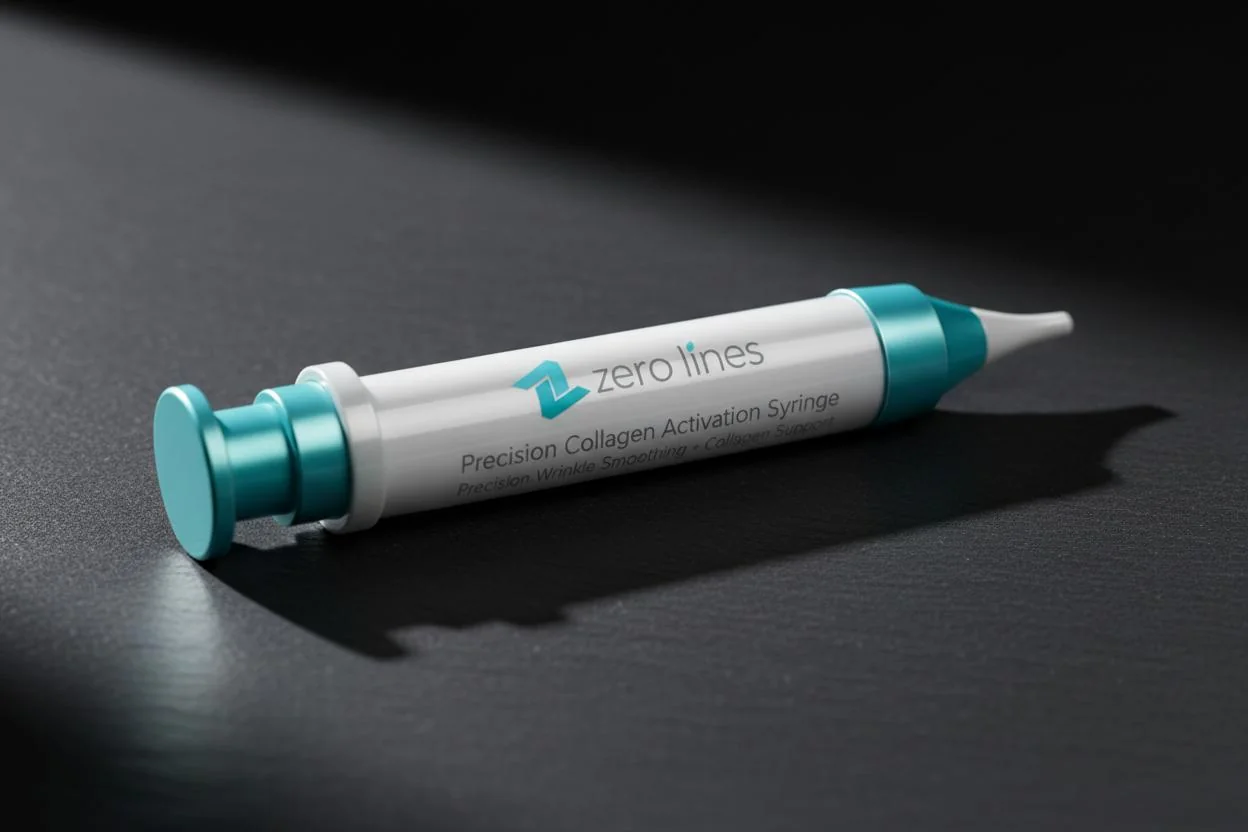
Precision Collagen Activation Syringe
Concentrated hydrolyzed collagen and botanical peptides designed to signal fibroblast activity and support structural renewal.
View Product →AI-Powered Analysis
See Your Skin Like Never Before
Upload a photo and answer 10 quick questions. Our AI analyses texture, tone, hydration, ageing signs, and lifestyle factors — then delivers a complete dermatologist-style report.
Analyse Your SkinCellular Senescence and Zombie Cells
One of the most fascinating discoveries in ageing research over the past decade is the role of senescent cells — cells that have stopped dividing due to damage or stress but remain metabolically active, releasing a cocktail of inflammatory molecules into surrounding tissue.
Scientists call them "zombie cells" because they refuse to die through normal programmed cell death. Instead, they linger and poison their neighbours. In skin, senescent fibroblasts and keratinocytes contribute to chronic low-grade inflammation, breakdown of the extracellular matrix, and impaired wound healing.
The implications for skincare are profound. Any effective anti-ageing strategy must either prevent cells from becoming senescent in the first place, or support the body's natural clearance mechanisms. Antioxidants help with the former. Certain botanical compounds — including some derived from Alpine plants that have evolved to survive extreme UV and temperature stress — appear to help with both.
Barrier Breakdown and Dehydration
The stratum corneum — the outermost layer of your skin — is essentially a brick wall. The bricks are dead skin cells called corneocytes. The mortar is a mixture of lipids including ceramides, cholesterol, and fatty acids.
As we age, this wall develops gaps. Lipid production decreases. The enzymes that help corneocytes shed properly become less efficient. The result is skin that looks dull, feels tight, and responds to irritants with redness or stinging.
Most people respond to barrier breakdown by piling on heavier moisturisers. But a compromised barrier needs more than occlusion. It needs the right lipids in the right ratios, delivered in a way that integrates with the existing structure rather than simply sitting on top of it.
This is where Pyrenean mineral water becomes relevant. High-altitude spring water carries dissolved minerals in ratios that closely match the skin's natural moisturising factors — magnesium, calcium, and trace elements that support barrier repair at the cellular level.
Pigmentation and Uneven Tone
Age spots, sun spots, and post-inflammatory hyperpigmentation share a common mechanism: melanocytes producing melanin in uneven patterns. What starts as a few barely-visible freckles in your twenties can become distinct dark patches by your forties.
The primary driver is cumulative UV exposure, which triggers melanin production as a protective response. But hormonal changes, inflammation, and even blue light from screens can contribute. The key to managing pigmentation is not bleaching — which damages the skin and often rebounds — but regulating melanocyte behaviour through consistent protection and gentle cellular turnover.
What Actually Works to Slow It Down
The research is surprisingly consistent on what slows skin ageing:
- Daily SPF 30+ — Non-negotiable. UV exposure is the single largest external driver of all four ageing mechanisms.
- Consistent hydration — Both topical (barrier-supporting formulations) and internal (adequate water intake).
- Gentle exfoliation — Weekly, not daily. Chemical exfoliation with AHAs or enzymes removes dead cells without micro-tearing.
- Peptide signalling — Small molecules that reach fibroblasts and stimulate collagen production.
- Antioxidant protection — Neutralising free radicals before they damage cellular DNA and proteins.
- Quality sleep — The majority of cellular repair happens between 11 PM and 2 AM.
The Zero Lines Protocol was built around these six pillars — each of the six formulations addresses one or more mechanisms in a specific sequence designed to respect the skin's biology rather than overwhelm it.
"Skin ageing is not a single process. It's the cumulative result of UV damage, collagen loss, glycation, inflammation, and gravity — all acting simultaneously. Addressing only one is like plugging one hole in a sinking boat."
— Zero Lines Clinical Advisory Board
Sources & References
- Zouboulis CC, Makrantonaki E. Clinical aspects and molecular diagnostics of skin aging. Clinical Dermatology. 2011;29(1):3-14.
- Krutmann J et al. The skin aging exposome. Journal of Dermatological Science. 2017;85(3):152-161.
- Makrantonaki E, Zouboulis CC. Molecular mechanisms of skin aging. Annals of the New York Academy of Sciences. 2007;1119:40-50.
- Rittié L, Fisher GJ. UV-light-induced signal cascades and skin aging. Ageing Research Reviews. 2002;1(4):705-720.
- Farage MA et al. Intrinsic and extrinsic factors in skin ageing. British Journal of Dermatology. 2008;159:16-20.
See Where Your Skin Stands
Our AI-powered Skin Analyser evaluates texture, tone, hydration, and ageing signs from a single photo — then builds a personalised protocol based on what your skin actually needs.
Analyse Your SkinRelated Reading


