
Two faces can look equally parched and need opposite things. One is short of oil. The other is short of water, and it may well be the shinier of the two. The distinction gets used loosely enough in marketing that it has started to sound invented, which is a shame, because the thing underneath it is real, and it decides whether the next product you buy does anything at all.
The difference is what is missing
Dry skin is a shortage of lipids. The outer layer of skin is usually described as bricks and mortar: flattened cells held together by a fatty matrix of ceramides, cholesterol and free fatty acids, with sebum sitting over the top. Some faces simply produce less of that material. Less mortar, a leakier wall, more water escaping into the air all day. That tendency is largely constitutional, and it is a good part of what people are actually describing when they talk about their skin type.
Dehydrated skin is a shortage of water in that same outer layer. It has nothing to do with what your skin produces. It is about what has been lost recently and not replaced, or what has been pulled out by dry air, heat, wind, aircraft cabins, long hot showers, a cleanser that strips more than it needs to, an exfoliating acid used with more enthusiasm than the skin had asked for.
So one is a supply problem and the other is a balance problem. This is why the same face can be oily and dehydrated at once with no contradiction at all. It is also why the two look so similar from a metre away — dull, tight, fine lines more legible than usual — and why a great many people spend a season treating the wrong one.
One is a trait, the other is a week
The most useful question is not what your skin looks like this morning. It is how long it has looked that way.
Dry skin is settled. It is how your face has behaved for years. Winter makes it worse and a humid August makes it easier, but it does not leave, and you have probably known about it since your twenties. Dehydration has a start date. You can usually name the week: three flights, a hotel with aggressive heating, a new foaming cleanser, a fortnight of retinoid enthusiasm, a holiday spent moving between sun and air conditioning.
Look back three months. If tight and faintly flaky is your baseline, you are dry. If you can point to roughly when it began, you are dehydrated. If you are dry and something recent has made it worse, you are both — which is the most common answer and, as it happens, the easiest to act on.
One complication is worth knowing. Sebum output tends to fall gradually across the decades, so someone who was oily and occasionally dehydrated at twenty-five can be genuinely dry at fifty-five. The answer you settled on ten years ago may have quietly expired. That drift belongs to the longer arc of how skin changes with age, and it is slow enough that most people miss the handover entirely.
The tell that catches people out

Here is the counter-intuitive one. Dehydrated skin often reads as oilier, not drier.
The pattern is easy to recognise once you have seen it: tight and faintly uncomfortable in the morning, unmistakably shiny by four in the afternoon, and still tight underneath the shine. People with this combination usually conclude they are oily, buy something more astringent, and make it worse. The common explanation is that skin increases sebum to compensate for a surface that is losing water too quickly. That is plausible and widely repeated. The honest limit of it is that the pattern is far easier to observe than the mechanism is to demonstrate in any particular face.
The visual tells repay learning. Fine, crepey lines across the cheeks or under the eyes that were not there last month, and that soften when you press a damp fingertip to them. Makeup that separates or clings by mid-morning. A brief sting when a serum goes on that never used to sting. And pores that look larger than they did — not because pores open and close, which they do not, but because skin holding less water sits less taut around each opening, so the opening reads bigger.
Genuinely dry skin looks different at close range. It is matte all day, faintly rough or dusty in texture, and it sheds in fine powdery scale rather than in patches. It rarely turns shiny at all, in any weather, at any hour.
Why the pinch test tells you almost nothing
Dry skin is short of lipids and is a settled trait you have probably had for years. Dehydrated skin is short of water in the same outer layer, and it has a start date you can usually name.
The pinch test turns up in nearly every article on this subject. Pinch the skin, usually on the back of the hand, watch how quickly the tent collapses. Slow means dehydrated. It is repeated with such confidence that it sounds like established practice.
It is established practice — for a different question. Skin turgor is a rough clinical sign of whole-body fluid loss, used by clinicians alongside several other observations, and it is blunt even there. What it registers is the behaviour of the whole tissue: dermis, elastin, subcutaneous fat, total body water. Cosmetic dehydration is a matter of the outermost layer, a few dozen micrometres deep. A pinch cannot feel a layer that thin.
On the face it is worse than unhelpful. Facial skin is thinner and more mobile, and elastic recoil slows with age regardless of how well hydrated anyone is. A well-hydrated sixty-year-old will fail the test. A badly dehydrated twenty-five-year-old will pass it comfortably. It reads age far more reliably than it reads water, which makes it, at best, a confusing input to a decision you are trying to get right.
Your own observations across a week — shine, tightness, how makeup sits, whether fine lines come and go — will tell you considerably more than any single manoeuvre performed once.
The Skin Analysis
See your skin as we see it
Free. Sixteen questions, one photograph, and an address to send it to. A written assessment across eight markers, and the protocol that follows from it — no account, no payment, about four minutes.
Begin the free analysisHumectant or lipid
This is the practical payoff, and it comes down to two categories of ingredient.
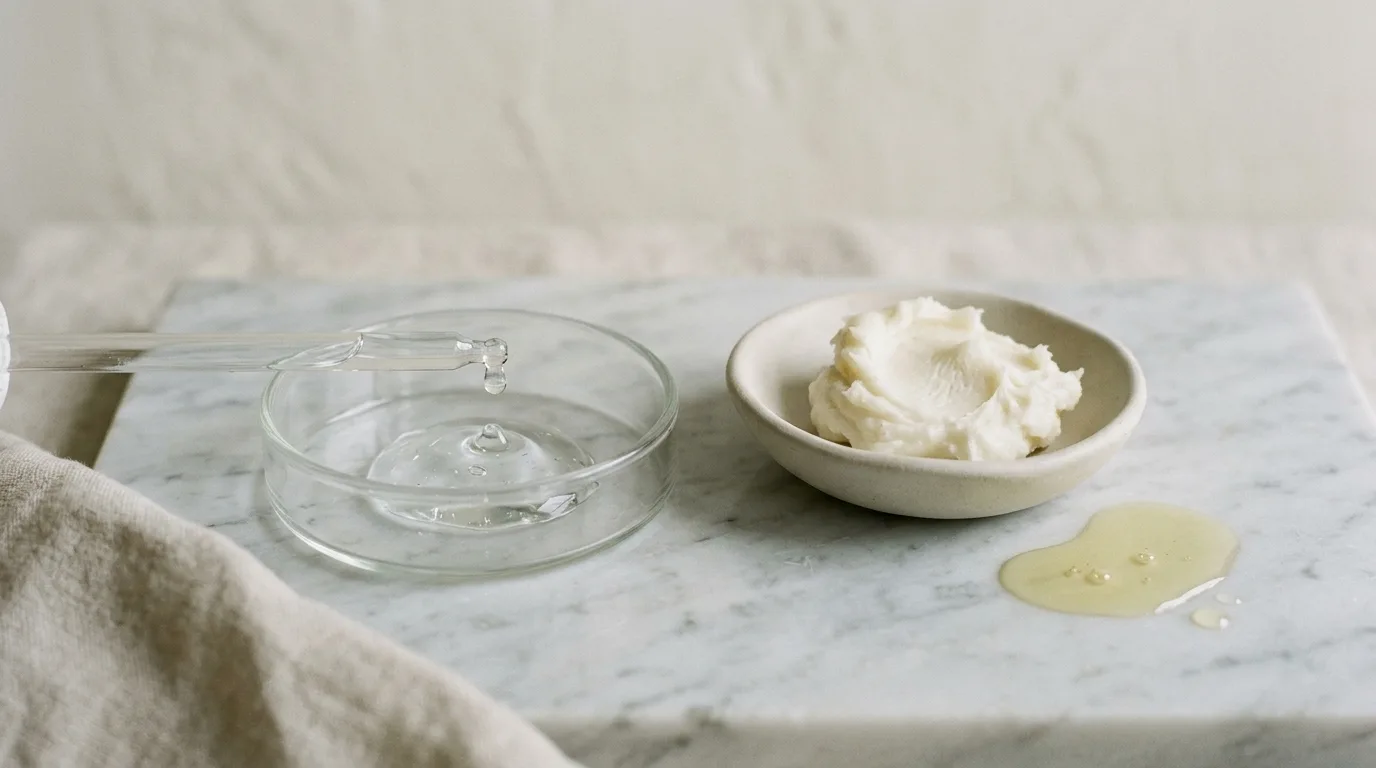
Humectants bind water and hold it in the surface layer: glycerin, hyaluronic acid, urea, panthenol, sodium PCA, various sugars. They are what dehydrated skin is short of. Lipids and occlusives supply the fatty material that keeps water from leaving: squalane, shea butter, ceramides, cholesterol, plant oils, petrolatum at the heavier end. They are what dry skin is short of.
If you are dehydrated, lead with a humectant, and put something over it. A humectant left bare on the face in genuinely dry air can draw water from the deeper layers up to the surface, where it evaporates, which is the mechanism behind hyaluronic acid feeling worse in dry air than in humid air. The humectant is not the problem. Leaving it uncovered is.
If you are dry, lead with lipids. A humectant on lipid-poor skin is water poured into a leaking container: you will feel the difference for an hour and lose it by lunch. And if you are both, the order is humectant onto damp skin, lipid on top. Nothing more complicated than that.
What to take away first
Before you add anything, look hard at what is already in the routine. Subtraction tends to move things faster than addition, and it costs nothing.
The usual suspects: a cleanser that leaves the face squeaky, which is the sensation of stripped lipids rather than of cleanliness; water hot enough to be enjoyable; exfoliating acids more than twice a week; two or three actives layered together because each was recommended on its own by someone who did not know about the others. Any of these can produce a face that looks dry while being nothing of the kind.
This is where the honest limit sits. For a fair number of people the answer is not a new product at all — it is a gentler cleanser and less frequent acid, and the face settles by itself in a fortnight. That is an unhelpful thing for a skincare house to say, and it happens to be true. We have nothing on sale yet, so there is nothing here we are steering you towards.
How to know within a fortnight whether you chose right
Change one thing. Not three. If you have decided you are dehydrated, add a humectant serum under whatever you already use and cover it. If you have decided you are dry, add a lipid-rich cream at night. Leave everything else alone and give it two weeks — long enough for the surface layer to turn over more or less completely, short enough that you can still remember where you started.
If you chose right, the reading is reasonably clear. Dehydrated skin given water and a lid tends to respond within days: the afternoon shine settles, the tightness beneath it goes, fine lines look softer in the mirror by the end of the first week. Dry skin given lipids moves more slowly and more steadily — less roughness, less flaking, comfort that holds through the day rather than for the hour after application.
If you chose wrong, that is legible too. A humectant on genuinely dry skin gives a pleasant hour and then nothing, and can feel faintly tacky by evening. A rich cream on skin that was only dehydrated feels heavy, pills under makeup, and does not settle the shine, because water was never what you were adding. Neither outcome is a setback of any consequence. Swap categories and run the fortnight again.
Two cautions. Do not run this experiment against drinking more water and expect to learn much: correcting a genuine shortfall in fluid intake does show on the face, while going from adequate to abundant largely does not, which is the narrower true thing about water intake and skin. And if skin is cracked, persistently itchy, or inflamed in a way that will not settle, none of the above applies. That is a question for a doctor, not for a moisturiser.
Sources & References
- The outer layer of skin is generally understood as a brick-and-mortar structure: flattened corneocytes set in a matrix of ceramides, cholesterol and free fatty acids, which together limit how quickly water leaves the skin. Epidermal lipids, barrier function, and desquamation
- Transepidermal water loss is a long-established measurement in skin research, and it is generally understood to rise when that lipid matrix is depleted, disrupted or stripped by surfactants. EEMCO guidance for the assessment of transepidermal water loss in cosmetic sciences
- Skin holds its own humectant system, commonly called natural moisturising factor — a mixture of amino acids, urea, lactate and salts inside the surface cells — and its levels are generally understood to vary with season, humidity and washing. Skin hydration: a review on its molecular mechanisms
- It is generally understood that humectants draw water both from deeper in the skin and from the surrounding air, so ambient humidity changes how they behave, and that occlusive or emollient materials slow the loss of that water to the atmosphere. Moisturizers: The Slippery Road
Related Reading




Explore Zero Lines
Maximise overnight repair with the Renewal and Repair Night Cream, formulated specifically to support your skin's circadian regeneration cycle.