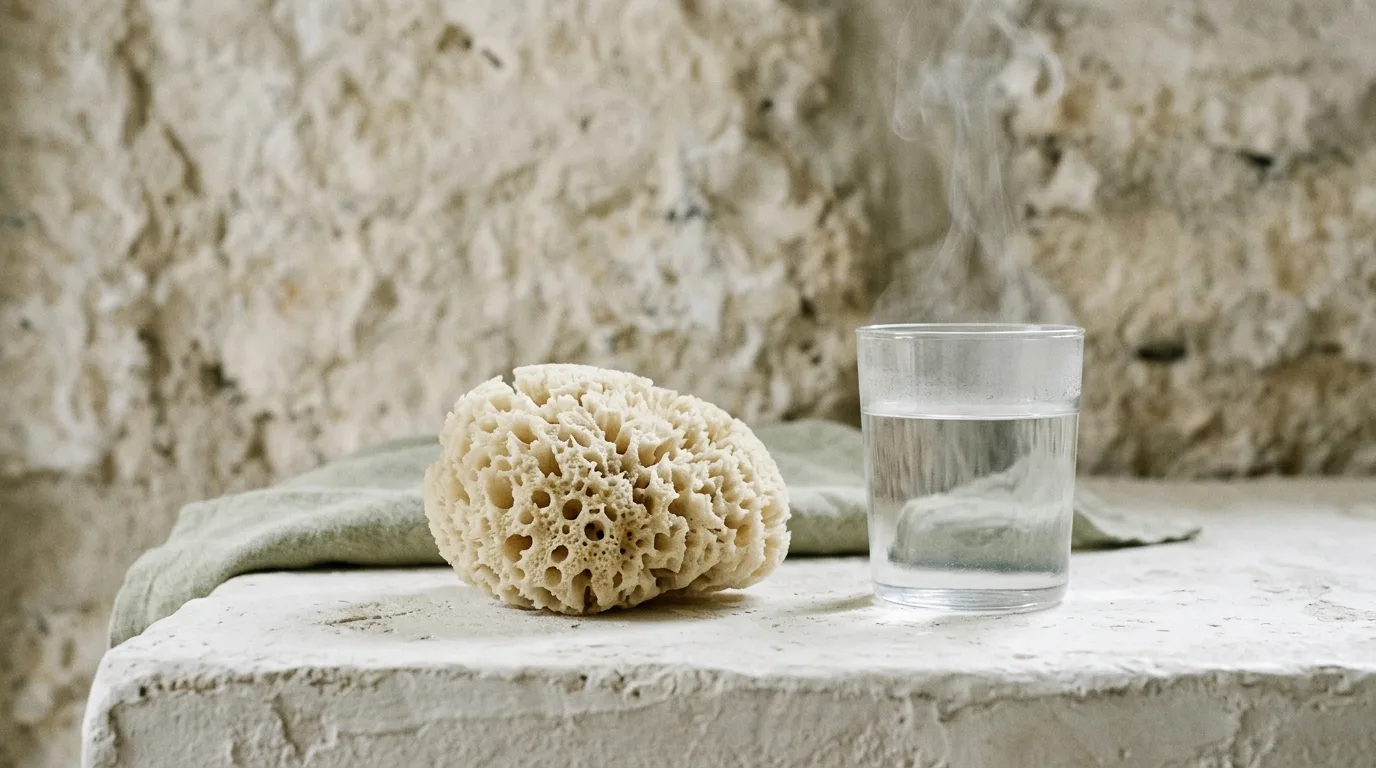
You cannot open a pore. You cannot close one either. There is nothing in there to open or close: no ring of muscle, no shutter, no valve. The whole vocabulary the industry uses around pores describes a mechanism that does not exist. What does exist is more interesting and more useful, because part of it you can influence and part of it was settled long before you bought your first cleanser.
What is actually down there
A facial pore is the opening of a hair follicle. Attached to the side of that follicle is a sebaceous gland, which makes oil and empties it into the shaft, and the oil travels up and out onto the surface. That is the entire apparatus. On the face the hair itself is usually so fine you never notice it, so what you see is the opening and whatever happens to be sitting in it.
There is no muscle around that opening. No sphincter, no valve, no ring of fibre that can tighten. The one muscle attached to a follicle is the arrector pili, which stands the hair up when you are cold or startled, and that is goosebumps. It does nothing to the width of the opening. Nothing in the structure is built to contract on cue, because nothing about the job requires it to.
Which leads somewhere unwelcome. The diameter of a follicle is set largely by inheritance and by how much oil moves through it, and no cream applied to the surface changes that number. What can change, genuinely and sometimes quite a lot, is how much of the opening you can see. Almost the entire perceived problem lives there.
Where opening and closing came from

The open-and-close vocabulary came out of the treatment room, and it came from something real. Steam a face for ten minutes and it behaves differently afterwards. Extractions get easier. It feels as though something has given way. What has actually softened is the contents: warm sebum is less viscous, and warm damp keratin swells and loosens its grip. The plug becomes moveable. The aperture is exactly where it was.
The cold rinse at the end is the other half of the ritual, and it also does something real, just not the advertised thing. Cold constricts the small vessels near the surface and briefly moves fluid out of the tissue, so the face looks less flushed and feels tighter for a while. It is the same effect as a chilled tool drawn across a puffy face in the morning, which is pleasant, visible, worth having, and entirely a matter of blood flow rather than follicles.
So temperature changes what you feel, and for an hour or two how the surface sits. It does not move the follicle wall in either direction. If the ritual leaves your skin looking better, believe your eyes. Just do not believe the explanation.
How full the pore is
There is no muscle around a pore — no sphincter, no valve, nothing built to contract. The one muscle attached to a follicle raises the hair, and that is goosebumps.
The single biggest variable in how visible a pore looks on a given day is how full it is. An empty follicle in relaxed skin is close to invisible. One packed with sebum and shed cells sits proud, catches shadow at the rim, and reads as a dot from a metre away.
When the top of that plug meets air it oxidises and darkens. That is what people are describing when they say blackhead: not dirt, not something that arrived from outside, but the skin's own material sitting at the surface long enough to change colour. Worth saying plainly, because the dirt story sends people off to scrub, and scrubbing roughens the surrounding surface without emptying anything.
How quickly a follicle refills depends mostly on how much oil the skin makes, which is a matter of hormones, age and inheritance rather than discipline. This is one of the few places where knowing what your skin actually does is practically useful: high sebum output means pores fill within a day of cleansing, low output means they can be left alone for much longer, and neither is a verdict on your routine.
Light, tension and years
A pore is a small pit, and a pit is visible because of shadow. Change the light and you change the problem. Low, raking light from above or the side throws a shadow into every opening, which is why pores look their worst in a lift, a changing room, or a bathroom with a downlight directly over the mirror. Flat, diffuse light from in front fills those shadows and they largely vanish. The skin did not change in the thirty seconds between the two rooms.
The second variable is how taut the skin immediately around the opening is. Well-watered skin sits plump against itself and holds the rim looking neat; skin that has lost water at the surface slackens a little and lets the edges splay. This is real, and it is also temporary, which is more or less the definition of dehydration as opposed to dryness. A face that has been properly moisturised does show smaller-looking pores by the afternoon, and shows them again the next morning if the water has gone.
The third is slower and matters more. The opening keeps its shape because of the collagen and elastin packed around it. Decades of ultraviolet exposure degrade both, and the tissue that held the rim tidy loosens. This is why pores on sun-exposed cheeks often stretch from round into an elongated oval, tilted downwards. It is a marker of accumulated light, not of poor cleansing. It is also the only change on this list that does not reverse.
The Skin Analysis
See your skin as we see it
Free. Sixteen questions, one photograph, and an address to send it to. A written assessment across eight markers, and the protocol that follows from it — no account, no payment, about four minutes.
Begin the free analysis
Three things that genuinely help
Cleanse twice a day, and do it without stripping. The point is to stop the follicle filling and oxidising, which means removing oil and the day's residue reliably rather than aggressively. A cleanser that leaves the face feeling tight has taken more than it needed to, and stripped skin looks duller and slightly rough, which does the shadow problem no favours at all.
Exfoliate on a schedule you can defend. Salicylic acid is oil-soluble, so it can get into the follicle rather than only working across the top of it, and at sensible intervals it keeps the contents from consolidating. The temptation is always to do more, and that is where most people come unstuck; the frequency question deserves proper thought, and measured exfoliation beats daily exfoliation more often than the shelf would have you believe. Retinoids are the other well-studied route to smoother-looking surface texture over months, though again the effect is on how the surface reads, not on the width of anything.
Protect from the sun, every day, for years. This is the least satisfying advice on the page, because none of it pays off this month. But the loosening of the structure around the follicle is what makes pores look permanently larger rather than temporarily so, and ultraviolet exposure is the main driver of it. Making sun protection an unremarkable daily habit will not shrink a pore. It protects the tissue that keeps the rim tidy, and over a decade that is the more valuable thing by a distance.
Two things that are theatre
The first is the steam-then-cold-water sequence sold as opening and closing. The steaming half is defensible as preparation, since softened contents genuinely help if someone trained is about to perform extractions. The cold half does nothing except feel decisive. And a long session of hot steam leaves plenty of people flushed and slightly irritated-looking for the rest of the evening, which is the opposite of what was wanted.
The second is pore strips and peel-off masks. They work in the narrow sense that they remove the top few millimetres of a plug and let you look at it afterwards, which is exactly why they are so satisfying. What they do not do is change the follicle. The gland keeps producing, the opening refills within days, and repeated aggressive removal can leave the skin around it looking red and roughened, which makes each opening catch more shadow rather than less.
The same logic covers astringent toners marketed as pore-minimising. Alcohol dehydrates the surface, dehydrated skin tightens briefly, and the effect lasts about as long as the sting. Nothing has happened to the follicle. Something has happened to your skin's water, and not in the direction you wanted.
The honest limit of this
Here is the summary nobody standing behind a counter is incentivised to give you. Pore size is mostly inherited. Oil output, which fills them, is mostly hormonal. Sun exposure, which loosens the structure around them, is cumulative and partly already spent. Between those three, most of what determines how your pores look was decided before you chose a cleanser.
What is left is not nothing. Keeping them empty, keeping the surrounding skin watered, and protecting the structure from further light all genuinely change how much shadow a face collects, and shadow is what you are actually looking at in the mirror. That is a narrower claim than the category usually makes. It is also the one that survives contact with the evidence.
One boundary worth naming. Congestion that is persistent, painful or inflamed rather than simply visible is a medical question and belongs with a doctor, not a skincare counter. Nothing described here is a treatment for anything.
We are writing this before we have anything to sell: six formulations in development, none of them on a shelf, no ingredient list published and no study completed. That makes the honest version easier to write. We would rather set the position now than promise something the skin was never going to do.
Sources & References
- What is generally understood about the anatomy of a facial pore: it is the surface opening of a hair follicle with a sebaceous gland attached, and the structure contains no muscular ring able to narrow or widen it. The only muscle attached to a follicle is the one that raises the hair. Anatomy, Hair Follicle (StatPearls, NCBI Bookshelf)
- It is broadly accepted in dermatology that how large a pore appears tracks with sebum output, and that sebum output is governed largely by hormones, age and inherited factors rather than by cleansing habits. Modulation of skin collagen metabolism in aged and photoaged human skin in vivo (Chung JH et al., J Invest Dermatol. 2
- The degradation of dermal collagen and elastin by cumulative ultraviolet exposure is among the most consistently reproduced findings in skin science, and is the usual explanation given for the elongated, oval pore shape seen on long sun-exposed areas such as the cheeks. Skin blood flow in adult human thermoregulation: how it works, when it does not, and why (Charkoudian N, Mayo Clin Pro
- The effects of temperature on skin are generally described in terms of blood flow and the viscosity of sebum, not in terms of any change to the diameter of a follicle.
Related Reading




Explore Zero Lines
Maximise overnight repair with the Renewal and Repair Night Cream, formulated specifically to support your skin's circadian regeneration cycle.