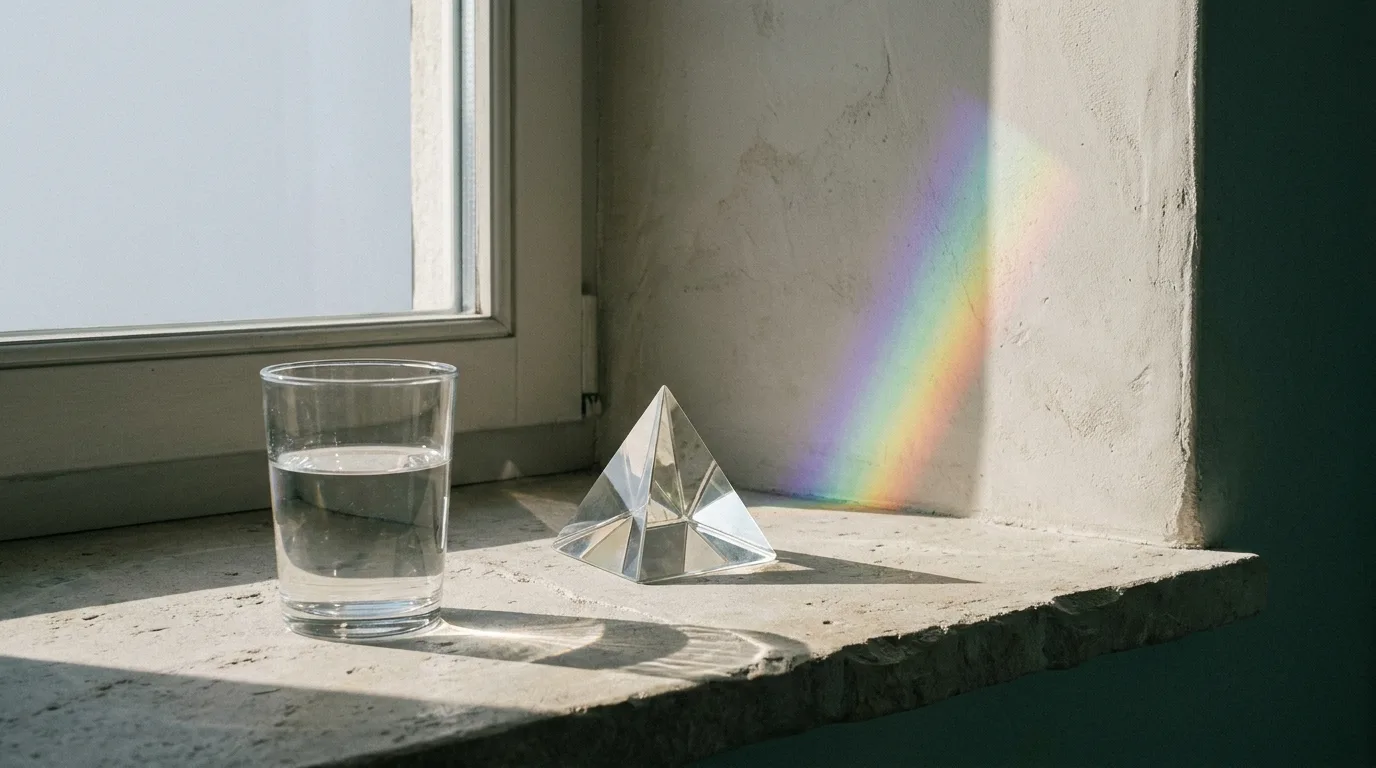
Visible light does have documented effects on skin, and blue light is part of visible light. Both of those are true, and a whole product category has been built on the distance between them and the conclusion people draw. The interesting question is not whether screens emit blue light — they do — but how much, compared with the thing already coming through the window.
What blue light actually is
Blue light is not a technology. It is the band of visible light running from roughly 400 to 500 nanometres, sitting immediately next to ultraviolet on the spectrum, and it is the reason the sky looks the colour it does. Your grandmother was exposed to it constantly. So was everyone before her.
It helps to know how sunlight is composed by the time it reaches the ground. Ultraviolet is the small slice, the part that burns and the part sunscreen was invented for. Most of what lands on your face is visible light and infrared. Blue occupies a substantial portion of that visible fraction, which means that on a short walk to the shops you receive a quantity of blue light no consumer device is built to produce.
Screens emit visible light because that is what a screen is for. LED backlights have a peak in the blue region, which is where the phrase high-energy visible light came from and where the marketing category was born. The name does useful work for the people using it: it sounds adjacent to ultraviolet. But the energy carried by a blue photon sits well below the level that breaks chemical bonds outright, which is why every proposed mechanism here is an indirect one — reactive oxygen species, signalling pathways, slow effects rather than immediate injury.
The comparison that never makes it onto the box

Dose is intensity multiplied by time, and this is where the category quietly comes apart. The blue-wavelength intensity reaching your face from a laptop is orders of magnitude below what open daylight delivers. A few minutes outside under a bright sky will exceed a full working day at a monitor. Not marginally. Not within a factor anyone could argue about over dinner.
Distance compounds it. Light spreads as it travels, so a screen sixty centimetres away delivers a modest fraction of its output to the small area that is your face, and a phone at reading distance is not much better placed. The sky, by contrast, fills your entire field of view, arrives from every direction at once, and does so for as long as you stand under it.
There is a sharper version of this point that most people miss. If you sit near a window, the light through that glass is the exposure worth thinking about. Glass stops nearly all UVB and a fair amount of UVA, but it passes visible light almost untouched. The blue light in your office is coming through the window, not out of the monitor, which is one of several reasons the case for sunscreen on an ordinary indoor morning is stronger than most people assume.

Where the evidence is genuinely good
Blue light is not a technology. It is the 400–500 nanometre band of ordinary visible light, the reason the sky is the colour it is, and everyone who has ever lived has been exposed to it.
None of this makes visible light inert, and we would be making the same error in the opposite direction if we said so. There is a real and repeatedly observed finding in photobiology: controlled exposure to visible light, particularly at the blue-violet end, can induce pigment production in skin. The darkening it produces can persist for weeks rather than fading over an afternoon.
The signal is clearest in skin that carries more melanin to begin with — deeper phototypes, broadly types IV to VI. That is not a footnote to the result; it is the shape of the result. Someone with very fair skin and someone with deep brown skin are not running the same experiment when they step outdoors, and research repackaged as a general threat to everyone has flattened the most useful thing it found.
There is a plausible mechanism, too. Melanocytes carry light-sensitive receptors from the opsin family, cousins of the proteins that let the retina see, which gives skin a route to respond to visible wavelengths directly rather than only through heat or ultraviolet damage. The outline of this is established. The detail is not, and anyone describing the pathway with complete confidence is some way ahead of the literature.
What the studies actually used
Here is the part that rarely travels with the headline. Those exposures come from solar simulators and filtered lamp arrays held close to the skin, delivering in twenty minutes or an hour what a screen would need an implausible stretch of continuous use to approach. Some of the most quoted work is done on cells in a dish: keratinocytes or fibroblasts under an LED, with no stratum corneum above them, no melanin overhead, no circulation bringing antioxidants in.
Every one of those differences runs the same way. The intensity is higher than a screen's. The spectrum is often narrow and weighted towards violet, where a display's output is broader and dimmer. The duration is compressed. The tissue is either simplified or wholly unprotected. Getting from there to a phone held at arm's length in a lit room is not a small step, and it is usually taken in a single sentence.
What would settle it is a long-run study of people living screen-heavy and screen-light lives, matched for sun exposure, sleep and age, with an endpoint about how their skin looks a decade later. As far as we are aware, no such study exists in a form that answers the question. So the honest position is that we do not know, and that here the evidence is thinner than the confidence around it.
The Skin Analysis
See your skin as we see it
Free. Sixteen questions, one photograph, and an address to send it to. A written assessment across eight markers, and the protocol that follows from it — no account, no payment, about four minutes.
Begin the free analysisThe desk, not the screen
The underlying observation is real enough. Skin does look duller at seven in the evening than it did at eight in the morning. The mistake is assuming the glowing rectangle is the variable, when a desk arrives with a dozen others attached to it.
Start with the air. Offices and home studies run heated or cooled almost continuously, and the conditioned air you sit in all day draws moisture off the skin's surface steadily enough to change how it looks by mid-afternoon. Add a day without much water, a face that has barely moved, and overhead lighting that flatters nobody.
Then there is the screen effect with the best support behind it, which has nothing to do with the skin surface. Bright light late in the evening shifts sleep timing, and sleep is when a great deal of the skin's overnight recovery happens. That places screens squarely among the ordinary daily habits that shape how skin ages — through the hour you fall asleep, not through photons landing on your cheek.
And if you want the honest ranking of what visibly ages a face, ultraviolet exposure sits at the top by a distance, followed by smoking, sleep debt and simple time. We set that hierarchy out at length in our full account of how skin ages. Screens do not appear on it. If they belong there at all, they belong far enough down that finding them would take better instruments than anyone currently has.
If your skin marks easily
For one group, visible light deserves a genuine thought: people whose skin darkens readily and then holds the mark for months. If that is you, the exposure that matters is daylight, and there is a plain formulation fact behind what helps. Iron oxide pigments — the tint in a tinted mineral sunscreen — attenuate visible light. The clear, cosmetically invisible UV filters largely do not. This is well understood in how sunscreens are built, and it is the reason a tinted product is the sensible choice for skin prone to uneven tone.
Notice what that recommendation is actually about. It is about the sun. A tinted SPF worn indoors to shield you from a monitor is theatre. Worn outdoors, it is doing something specific and defensible.
The antioxidant argument behind almost every blue-light product is the plausible one: visible light generates reactive species, antioxidants neutralise reactive species, therefore. We would rather be careful about the therefore. Plausible in principle is a long way from demonstrated on intact human skin at the intensities a screen produces, and this category is generally sold as though that gap had been closed.
One boundary matters more than the rest. Pigment changes that persist, spread or alter can be medical, and several of them have names, and treatments, that belong to a dermatologist. Skincare is the wrong instrument for that conversation and a shelf of serums is the wrong place to have it.
How to read a blue-light claim
Four questions handle most of them. At what intensity was the effect shown? Over what duration? In what tissue — living skin, or cells in a dish? And compared with what the sun does in the same period? A result produced by a violet lamp held close to the skin for an hour is not a statement about your evening scroll, however carefully the sentence has been arranged around it.
The category has the shape unfalsifiable ideas tend to take in skincare. The harm is invisible, cumulative and impossible for you to verify, so the product can never be seen to fail. The belief that skin stops responding to a product it has used for months works the same way, and survives for the same reason: nobody can run the experiment on themselves.
Our own position is easy to state. Zero Lines has six formulations in development and not one of them is a blue-light product. We read this evidence and it did not support building one, and we would rather say that than invent a threat and then sell you protection from it. If the research moves — and the pigmentation work is the part most likely to move — we will tell you here.
For now: the sun is the source, the window matters more than the monitor, and the screen is a small thing wearing the costume of a large one.
Sources & References
- The composition of sunlight at ground level — a small ultraviolet fraction, with visible light and infrared making up the great majority — is settled physics, measured and tabulated in standard solar irradiance references for decades. Solar and Ultraviolet Radiation. IARC Monographs on the Evaluation of Carcinogenic Risks to Humans, Volume 55 (Interna
- That visible light, particularly at the blue-violet end, can induce lasting pigmentation in melanin-rich skin is a repeated finding in photobiology, established with controlled light sources at intensities well above anything a household screen produces. Regazzetti C, Sormani L, Debayle D, Bernerd F, Tulic MK, De Donatis GM, Chignon-Sicard B, Rocchi S, Passeron T. Melano
- The presence of light-sensitive opsin receptors in melanocytes is now generally accepted in the dermatological literature; the pathway is understood in outline rather than in full. Morgado-Carrasco D, Piquero-Casals J, Granger C, Trullàs C, Passeron T. Melasma: The need for tailored photoprotection
- That iron oxide pigments attenuate visible light while conventional clear UV filters largely do not is well established in sunscreen formulation science, and is why tinted mineral products are recommended for skin prone to uneven tone.
Related Reading




Explore Zero Lines
Maximise overnight repair with the Renewal and Repair Night Cream, formulated specifically to support your skin's circadian regeneration cycle.