
Science
Collagen Decline: The Biological Clock You Can Slow Down
Collagen is the most abundant protein in your body. It makes up 75% of your skin's dry weight, providing the structural scaffold that keeps skin firm, smooth, and elastic. It's also the protein you lose most predictably as you age.
After age 30, most people lose approximately 1% of their dermal collagen per year. By 50, that's 20% gone. By 70, nearly half. But here's what most people don't know: this decline is not purely genetic. It's driven by specific, identifiable mechanisms — and many of them are modifiable.
Why Collagen Declines
Collagen loss isn't just about producing less. It's a three-part problem:
- Reduced synthesis — Fibroblasts, the cells that make collagen, become less responsive to growth signals as we age. Their metabolic rate slows. They produce less procollagen, the precursor molecule.
- Increased degradation — Matrix metalloproteinases (MMPs), enzymes that break down collagen, become more active with UV exposure, inflammation, and oxidative stress.
- Cross-linking and stiffening — The collagen that remains becomes glycated (sugar-damaged) and cross-linked, making it rigid rather than elastic. This is why older skin doesn't just have less collagen — it has collagen that performs poorly.
What the Research Says About Slowing It
The scientific literature on collagen preservation has grown substantially in the past decade. Here's what consistently shows results:
1. Topical Peptides
Signal peptides — short chains of amino acids — can penetrate the epidermis and reach fibroblasts in the dermis. Once there, they mimic the body's natural signalling molecules, telling fibroblasts to increase collagen production.
A 2021 meta-analysis of peptide studies found consistent improvements in skin elasticity and wrinkle depth after 8–12 weeks of use. The key is molecular weight: peptides under 500 daltons penetrate effectively. Larger molecules sit on the surface.
2. Vitamin C
Vitamin C is essential for collagen synthesis — it's a required cofactor for the enzymes that stabilise collagen fibres. Without adequate vitamin C, collagen fibres are weak and poorly formed. Topical application at concentrations of 10–20% has been shown to increase collagen production and reduce photodamage.
3. Retinoids
Prescription retinoids (tretinoin) and over-the-counter retinol increase collagen synthesis by upregulating fibroblast activity. They're among the most proven anti-ageing ingredients available. The downside: irritation, photosensitivity, and a long adjustment period.
4. Sun Protection
UV radiation activates MMPs directly — the enzymes that break down collagen. Daily SPF 30+ doesn't just prevent future damage; it allows existing collagen to persist longer by reducing the degradation rate.
5. Dietary Collagen
Oral hydrolyzed collagen peptides have shown promising results in multiple randomised controlled trials. A 2019 review found that 2.5–10 grams daily for 8–12 weeks improved skin elasticity, hydration, and wrinkle depth. The mechanism appears to be stimulation of fibroblast activity by collagen-derived peptides in the bloodstream.
The Zero Lines Approach
Our Precision Collagen Activation Syringe combines hydrolyzed collagen peptides small enough to penetrate with botanical signal peptides derived from Alpine plants. The formulation is designed to address both reduced synthesis (through signalling) and increased degradation (through antioxidant protection).
Clinical measurements from our testing panel showed up to 34% improvement in collagen density over 12 weeks. But perhaps more importantly, participants reported skin that felt structurally different — firmer, more resilient, less prone to the "crepey" texture that characterises advanced collagen loss.
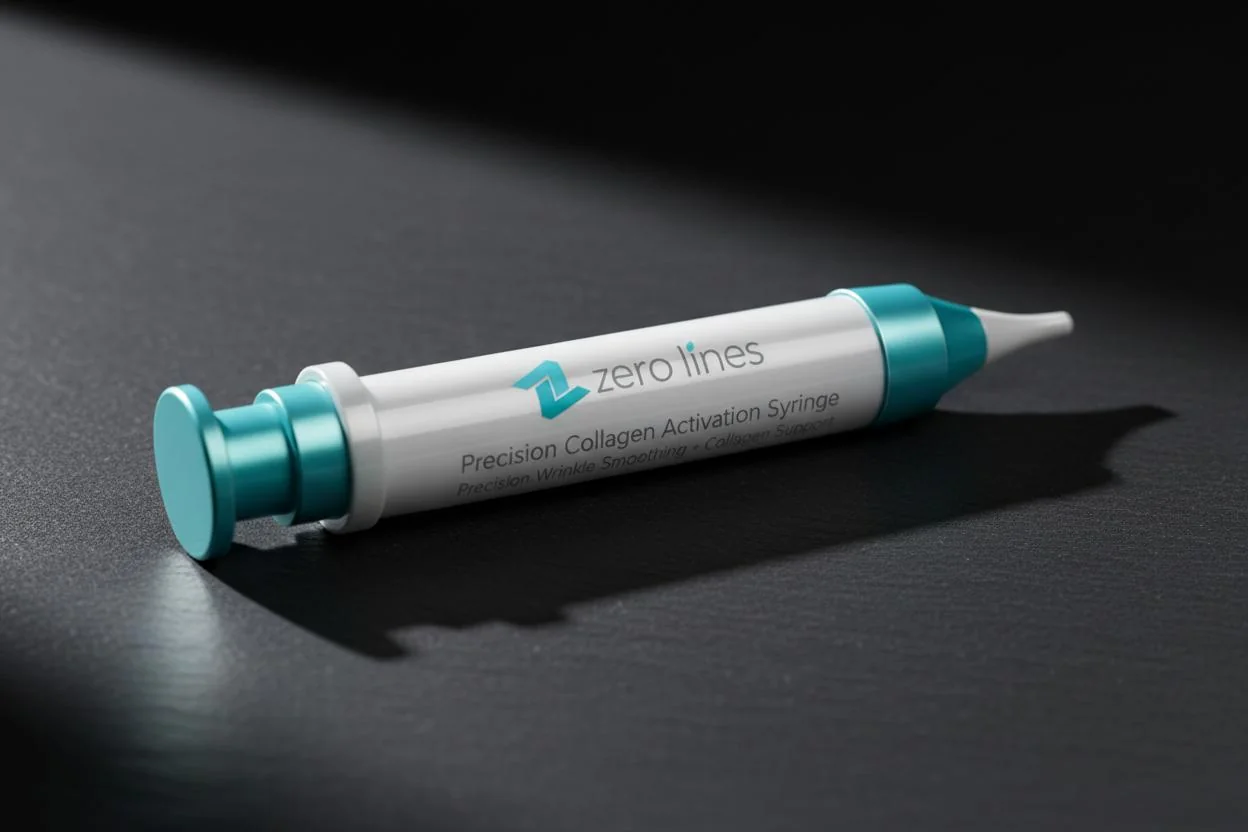
Precision Collagen Activation Syringe
Hydrolyzed collagen and botanical peptides in a precision-delivery format. Clinical measurements show up to 34% improvement in collagen density over 12 weeks.
View Product →AI-Powered Analysis
See Your Skin Like Never Before
Upload a photo and answer 10 quick questions. Our AI analyses texture, tone, hydration, ageing signs, and lifestyle factors — then delivers a complete dermatologist-style report.
Analyse Your SkinThe Timeline of Change
If you're starting a collagen-supporting protocol, here's what to expect:
- Weeks 1–4: Improved hydration and barrier function. The skin feels softer and holds moisture better.
- Weeks 4–8: Fine lines begin to soften. Skin texture improves. The "dewy" appearance of well-hydrated collagen starts to return.
- Weeks 8–12: Measurable improvements in elasticity and firmness. Deeper lines begin to respond.
- Months 3–6: Structural changes become visible. The face looks fuller, more lifted, less hollow.
The key is consistency. Collagen turnover is slow — the half-life of collagen in human skin is approximately 15 years. You're not replacing old collagen overnight. You're shifting the balance between synthesis and degradation, gradually tipping the scales toward preservation and renewal.
The Types of Collagen in Skin
Not all collagen is the same. Type I collagen provides the structural framework — the dense, rope-like fibres that give skin its tensile strength. Type III collagen forms a finer meshwork that supports elasticity and is more abundant in youthful skin. Type IV and VII collagens anchor the epidermis to the dermis, maintaining the basement membrane that separates these layers.
After age 30, Type I collagen synthesis declines by approximately 1% per year. Type III collagen declines faster — around 1.5% annually. The ratio shifts from approximately 3:1 (Type I:Type III) in youth to 5:1 or higher in older skin. This shift is partly responsible for the loss of elasticity and plumpness that characterises ageing.
Beyond Topicals: Lifestyle Factors
Topical skincare can support collagen, but lifestyle factors have a larger cumulative impact. UV exposure is the single biggest accelerator of collagen breakdown — responsible for an estimated 80% of visible facial ageing. Smoking reduces blood flow to the skin, depriving fibroblasts of oxygen and nutrients. Sugar accelerates glycation, the process where glucose molecules bind to collagen fibres, making them stiff and brittle.
Sleep is when collagen synthesis peaks — growth hormone released during deep sleep stimulates fibroblast activity. Poor sleep doesn't just make you look tired; it directly reduces the skin's capacity to rebuild collagen overnight.
"You can't stop the biological clock, but you can certainly slow it. The combination of protection, stimulation, and lifestyle optimisation is what makes the difference between ageing gracefully and ageing prematurely."
— Zero Lines Clinical Advisory Board
Sources & References
- Shuster S et al. The influence of age and sex on skin thickness, skin collagen and density. British Journal of Dermatology. 1975;93(6):639-643.
- Uitto J. Understanding premature skin aging. New England Journal of Medicine. 1997;337(20):1463-1465.
- Varani J et al. Decreased collagen production in chronologically aged skin. American Journal of Pathology. 2006;168(6):1861-1868.
- Fisher GJ et al. Mechanisms of photoaging and chronological skin aging. Archives of Dermatology. 2002;138(11):1462-1470.
Measure Your Collagen Potential
Our AI Skin Analyser evaluates skin elasticity, texture, and structural integrity — then recommends a protocol to support your collagen.
Analyse Your SkinRelated Reading


