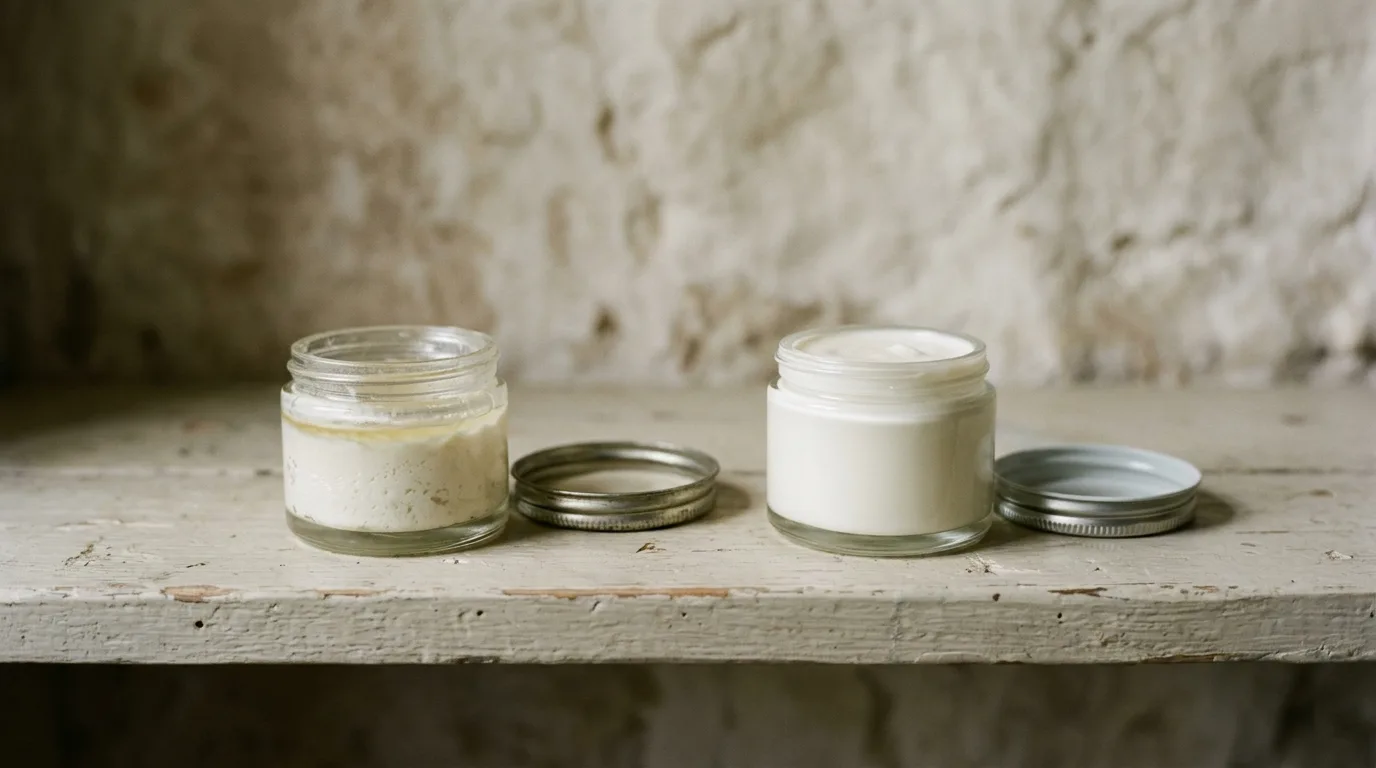
There is a small open jar printed somewhere on the back of almost everything in your bathroom, with a number and an M inside it. 12M. 6M. 24M. Most people read it as an expiry date, which it is not, and then ignore it, which is mostly fine. It is worth about ninety seconds of your attention, because what it promises is narrower and rather more interesting than the internet suggests.
What the open jar is actually promising
The number inside the jar — 6M, 12M, 24M — is months. Not months from manufacture, and not from purchase. Months from the moment you break the seal. This is the period after opening, and under European and UK cosmetics rules it appears on products expected to keep for more than thirty months unopened. So a 12M jar tells you two things at once: sealed, it should be good for at least two and a half years; opened, the maker expects it to hold for a year of ordinary use.
It sits on the same crowded back panel as the ingredient list, in grey type at about four points, and it is the part of that panel almost nobody reads. Behind the number sits real work: batches held at elevated temperature to simulate ageing, formulas deliberately inoculated with bacteria and yeast to see whether the preservative system holds them. Standard safety practice, not a marketing exercise.
What the number is not is a measurement of your jar. It is an estimate built on assumptions about how a reasonable person stores and uses a product. Treat it as a floor for safety rather than a ceiling for quality: a formula can be entirely safe in month eleven and still not be the thing it was in week one.
A best-before date is a different promise
The other mark is a small hourglass, or the words best before end of followed by a date. It appears on products whose unopened life runs shorter than thirty months — unstable actives, minimal preservation, a high proportion of unrefined botanical material. That date runs from manufacture and takes no interest in whether you have opened the box. A serum bought in a sale two summers ago has been ageing on the shelf either way.
Sun protection is where dates matter most and get ignored most. Filters degrade, and a bottle that spent August in the footwell of a car in Marbella has had a harder year than the print on its base suggests. If you cannot remember which summer a sunscreen came from, replace it. Cheapest decision in this article.
Some products carry both marks, which is not a contradiction: one governs the sealed life, the other the opened one, and whichever runs out first applies. Anything that came from a pharmacy on prescription is a separate matter — it follows the instructions it arrived with, not the conventions of the cosmetics aisle.
What actually degrades, and roughly in what order
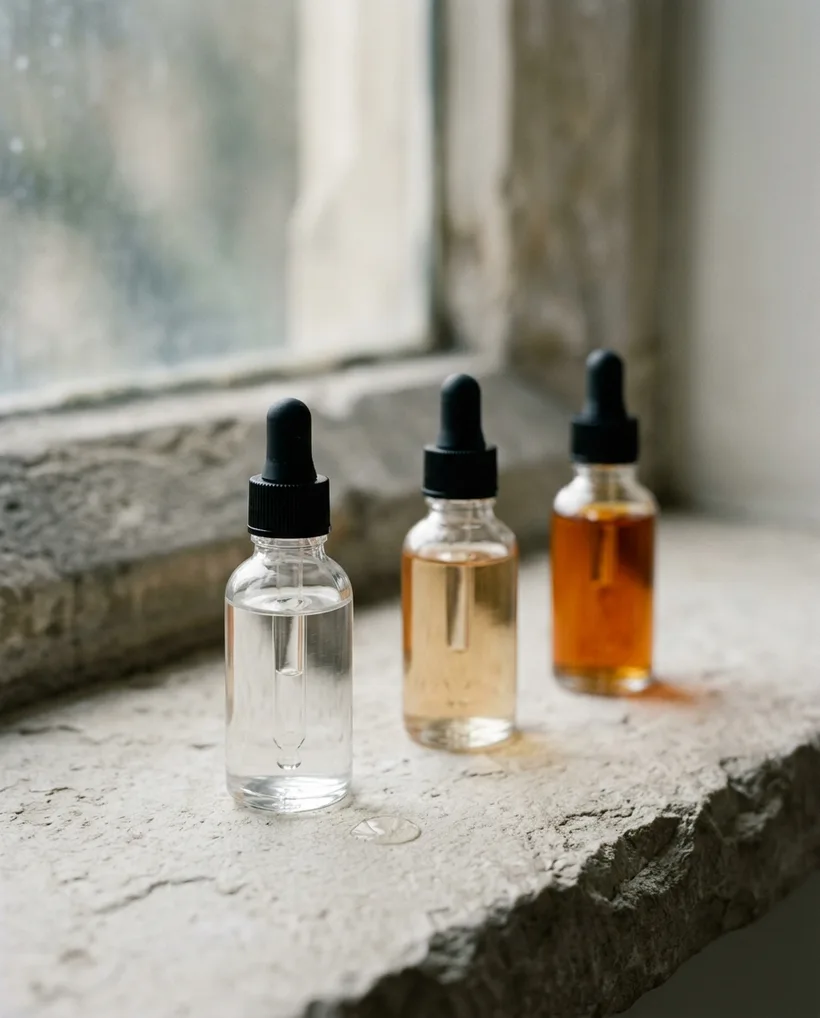
There is no single clock. A formula has at least three, running at different speeds: the actives, the oils, and the preservative system. Products rarely fail all at once. They lose one thing at a time, and usually the most interesting thing first.
Antioxidants go first, and pure vitamin C fastest of all. The reactivity that makes L-ascorbic acid worth formulating with is exactly what makes it fragile: in water, with oxygen and warmth and light available, it oxidises, and the products of that reaction are coloured. This is why a clear serum turns amber and then orange. The colour is not a flaw occurring alongside the degradation. The colour is the degradation, made visible.
Oils are next, on a slower schedule. Unsaturated plant oils — rosehip, evening primrose, a good many seed oils — react with air over time, and rancidity has a smell that is unmistakable once you have met it: old nuts, wax crayons, the inside of a paint tin. Vitamin E in a formula slows that down, partly by being spent on it. Your nose finds this long before any printed date does.
Preservative systems are the quiet one. They are not inert passengers; they are consumed. Every finger into a jar introduces organisms, and the system spends a little of itself dealing with them. Peptides have a vulnerability of their own — short chains of amino acids sitting in water, and water is patient. Keeping them intact on a shelf is a real formulation problem, and it applies whether the peptide came from a plant or a synthesiser. Most of that work happens years before anything reaches a customer, in the unglamorous half of the laboratory where samples sit in ovens waiting to fail.
The signs worth noticing
The open jar with a number and an M is the period after opening — months from breaking the seal, not from manufacture or purchase. It appears on products expected to keep for more than thirty months unopened.
Smell first, always. It is the most sensitive instrument you own and it costs nothing. Rancid oil, the sour or faintly yeasty note of something growing, the flat absence of a scent that used to be there — these arrive before anything visible does.
Then colour, with a caveat. Formulas carrying unrefined botanical material vary from batch to batch, and a product that was never white is not misbehaving by being beige. What matters is drift: a pale thing gone steadily darker while in your possession, or brown creeping in at the neck of the bottle where the air sits.
Then texture. Some separation is designed in — a formula with little emulsifier will part, and the instruction to shake it is on the label for a reason. The separation worth minding is the kind that will not go back together: water beading out of a cream, a lotion that thinned once and stayed thin.
The honest limit is that none of this detects microbiological contamination reliably. A product can be well past its useful life and look, smell and feel entirely normal. That is precisely why the period after opening exists — it stands in for a thing you cannot check at home. And if something you have used happily for months begins to sting, redden or itch, stop; if that continues, it is a question for a doctor rather than for a symbol on a box.
The Skin Analysis
See your skin as we see it
Free. Sixteen questions, one photograph, and an address to send it to. A written assessment across eight markers, and the protocol that follows from it — no account, no payment, about four minutes.
Begin the free analysisHeat and light matter more than dates
Chemistry offers a crude rule of thumb: reaction rates roughly double for every ten degrees of warming. Crude, but directionally right and worth carrying around. A cream living at twenty-eight degrees is on a meaningfully faster clock than the same cream at eighteen, and nothing printed on the base adjusts for that.
Which brings us to the bathroom: the worst room in the house for storing skincare, and the room in which essentially all of it is stored. Consider what happens there twice a day. Humidity near saturation. Temperature swinging ten or fifteen degrees inside twenty minutes. A cabinet on the wall, which is where warm air goes, and in winter a radiator beneath it. Add a window and you have added light. A bedroom drawer — cool, dark, dull — will do more for a formula than anything else suggested here.
Packaging is the other half of the same problem, and good packaging does real work: amber glass, opaque tubes, pumps that never let air back in. A wide-mouthed jar with a screw lid is the least protective format available and reliably the most photogenic, which tells you something about how that decision gets made. When you look at what you are actually paying for in a jar of cream, the container is one of the few line items that earns its keep twice: once in the shop, and again in month nine.

The fridge is not the answer people assume
The reasoning is sound as far as it goes. Cold slows reactions, a fridge is cold, therefore the fridge must be the right home for skincare. The first two hold. The conclusion mostly does not.
A domestic fridge sits around four degrees, is humid, and is opened a dozen times a day. Emulsions can destabilise at low temperature, and several are built for a narrower range than people assume. Thick creams stiffen, waxes crystallise, and a product taken out warm and put back cold cycles through condensation every time — moisture gathering around the neck and under the lid, which is exactly what a preservative system is there to fight.
The exceptions are narrow and real. A label that says refrigerate means refrigerate. A high-strength ascorbic acid preparation in a small dark bottle is a reasonable candidate, provided it will be used quickly. Eye gels and sheet masks feel wonderful cold, which is a genuine reason, just not a chemical one. Everything else wants cool, dark, dry and consistent. Consistency beats cold.
Most jars are finished long before they turn
Here is the arithmetic that quietly settles most of this. A 50 ml moisturiser, used morning and night at something like half a millilitre a time, is empty inside two months. A 30 ml serum, a few drops once a day, lasts perhaps three. Set against a 12M symbol, neither comes near the boundary. If you use a thing daily, the number on it is close to irrelevant.
The products that spoil are the ones you do not use. The oil bought on holiday and used twice. The third serum in a routine with room for one. The gift set opened in December and remembered in September. Each was fine on the day it was abandoned, and none of them were fine a year later at the back of a warm drawer. The real cost in most bathrooms is not spoilage; it is money spent on things that were never going to be finished.
Zero Lines has nothing on sale yet, so this is not advice with a purchase attached to the end of it. When our six formulations do exist they will carry the same small open jar as everything else, because the rules require it and because printing it is sensible. What we will not tell you is that ours are somehow exempt from oxygen and warmth. Nothing is. The useful version is duller: buy the size you will genuinely finish, keep it out of the bathroom, and use it.
Sources & References
- It is generally understood that European and UK cosmetics rules require either the open-jar period-after-opening symbol or a date of minimum durability, depending on whether a product is expected to keep beyond thirty months unopened. Regulation (EC) No 1223/2009 on cosmetic products — Article 19 (Labelling)
- Preservative efficacy testing — deliberately introducing bacteria, yeast and mould into a formula to see whether its preservative system controls them — is standard practice in cosmetic safety assessment, and is much of where period-after-opening figures come from. Stability of vitamin C derivatives in solution and topical formulations
- The oxidation of L-ascorbic acid in water, accelerated by oxygen, warmth and light and producing coloured degradation products, is long-established and uncontroversial chemistry. Role of physical structures in bulk oils on lipid oxidation
- That unsaturated oils react with air, heat and light to produce the characteristic odour of rancidity is well established in food science, and applies in the same way to the oils used in cosmetics.
Related Reading




Explore Zero Lines
Maximise overnight repair with the Renewal and Repair Night Cream, formulated specifically to support your skin's circadian regeneration cycle.