
Every skincare brand has an origin story. Most sound the same: a founder with sensitive skin who couldn't find products that worked, then a eureka moment in a bathroom. Zero Lines started differently. It started with a question, a spreadsheet, and a lot of failed prototypes.
Year One: Why Does Most Skincare Fail?
The question was simple: why does most skincare fail to deliver measurable results? We spent the first year reading the research. Not marketing claims — peer-reviewed studies on how ingredients penetrate the skin and how formulas hold up over time. What we found was unsettling.
Most products contain actives at concentrations below the threshold for efficacy. Many use unstable forms of vitamins that degrade before reaching the skin. Formulations are often designed for texture and shelf appeal rather than biological activity. And when multiple actives are combined without regard for pH compatibility, molecular weight or delivery mechanism, many simply neutralise each other before they reach their target.
We decided to build something different: a system where every ingredient is present at an effective concentration, in a form that remains stable, delivered in a sequence that maximises penetration. Not a product. A protocol.
Year Two: Testing 14 Mineral Waters
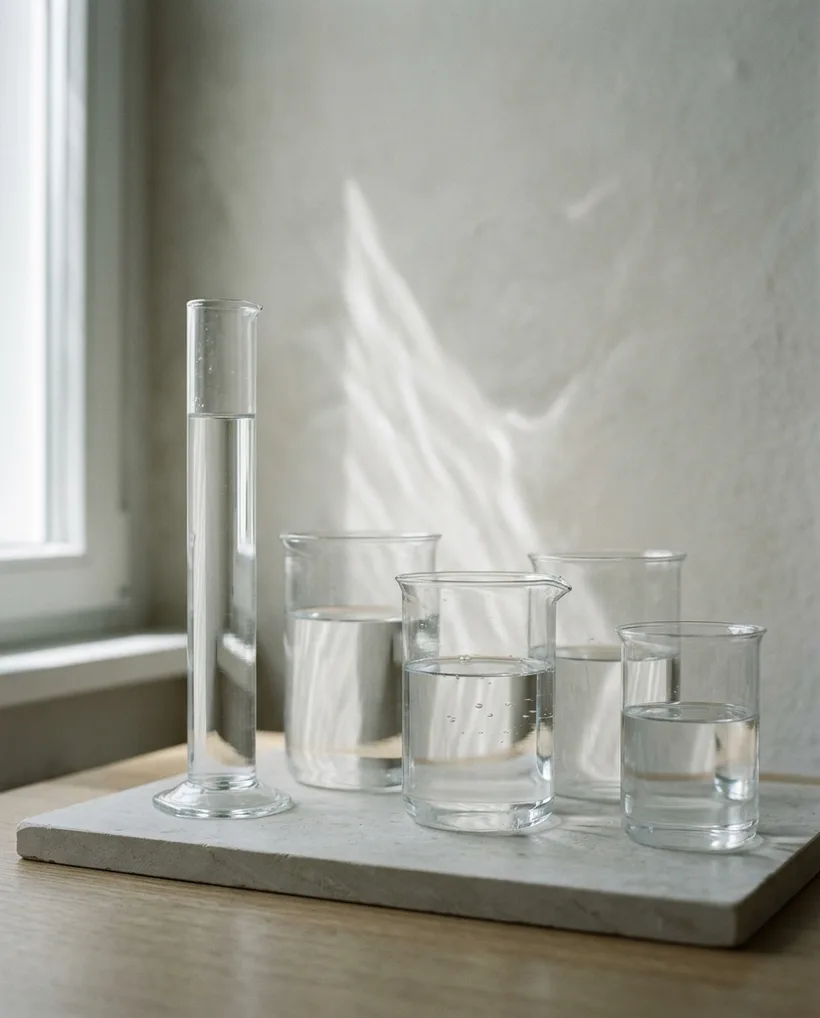
We started with the water. Not because it's the most exciting ingredient, but because it's the most important. Water makes up 70–90% of most skincare formulations. If the water is inert, you've wasted most of your formula.
We tested mineral waters from 14 springs across the Pyrenees, Alps, and Cantabrian Mountains. We measured pH, mineral content, bacterial load, and stability. We tested how each water interacted with common actives — did it support vitamin C stability? Did it alter peptide conformation? Did it affect emulsion viscosity?
The Andorran spring we eventually selected wasn't the highest in minerals or the most famous. It was the most consistent, the most compatible, and the most sustainable. That decision — to prioritise function over story — set the tone for everything that followed.
Year Three: The Prototypes That Failed
Failure is where most of the learning happened. The first Line Corrector formulation used native collagen, which turned out to be far too large to penetrate. The first Night Cream was too rich; enough volunteers broke out that it went straight back to the bench. The first Peeling Gel used glycolic acid: effective, but too irritating for weekly use.
Each failure led to a reformulation. Native collagen became hydrolysed collagen. The Night Cream's lipid ratio was rebalanced. The Peeling Gel's acid was replaced with enzymatic brown algae extract. By the end of year three, we had 200+ prototypes and a clear sense of what worked.
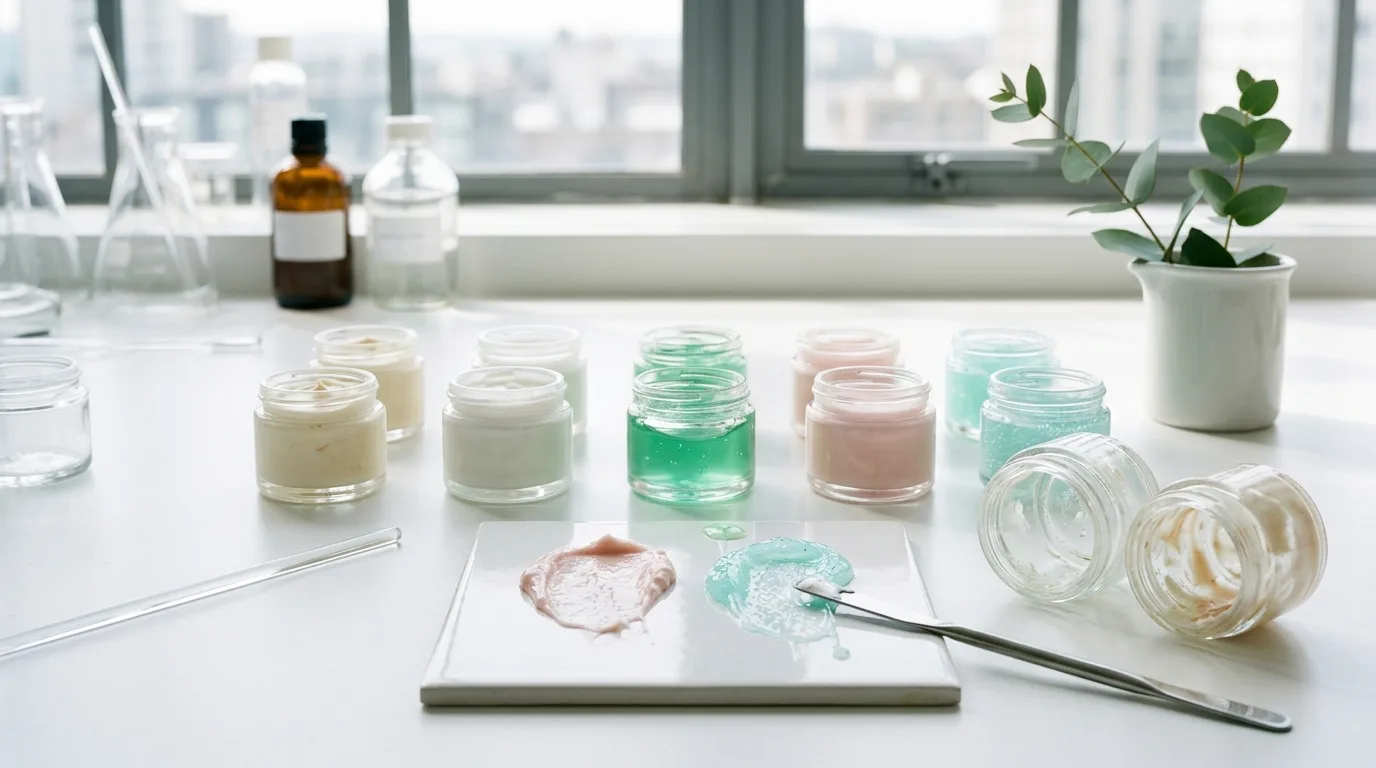
Year Four: Building the 6-Step System
The breakthrough wasn't a single ingredient or product. It was the realisation that the sequence mattered as much as the contents. A collagen peptide applied to unprepared skin penetrates poorly. A moisturiser applied over a serum pushes actives deeper. An exfoliant used before a repair cream creates a window of enhanced absorption.
We mapped the interactions between every pair of products in the system. We tested morning sequences versus evening sequences. We evaluated wait times, layering orders, and seasonal variations. The result was the 6-step Zero Lines Protocol — not six independent products, but one coordinated system.
How Zero Lines Formulations Are Tested
Every formulation had to earn its way through three stages.
Stage 1: The bench. We tested penetration using Franz diffusion cells, checked stability under accelerated ageing conditions (40°C and 75% humidity for three months), and confirmed each formula stayed compatible with the others in the system.
Stage 2: Real skin. A four-week panel, tracking hydration with corneometry and barrier function through transepidermal water loss — and asking the unscientific questions alongside them. How does it feel? How does it smell? Would you keep using it?
Stage 3: The full protocol. A twelve-week run of the complete six-step sequence, with density and elasticity followed by cutometry and tonometry and photography under standardised conditions.
That is the programme each formulation is built to pass before it is sold. Stage 1 is done. Stages 2 and 3 belong to a collection that has not launched — we will publish what they find, with the method attached, and until then we have nothing to cite and will not pretend otherwise.
What's Next for Zero Lines
Four years brought us to six formulations. The next phase is already underway: a body care extension using the same Alpine mineral water base, and an eye-specific formulation targeting the thinner, more delicate periorbital skin.
The question that started it all — why does most skincare fail to deliver? — has been answered. Now the question is: how far can we push what's possible when biology, geography, and craft converge?
The Zero Lines Formulation Philosophy
When we started Zero Lines in 2021, we had a clear constraint: every ingredient must serve a functional purpose. No fillers. No fragrance for fragrance's sake. No colours that don't contribute to stability. This sounds obvious, but it's surprisingly rare in cosmetics, where formulas are often bulked out with cheap silicones and thickeners to reduce cost.
Our first decision was the water base. We tested 14 mineral springs across Europe before selecting our Andorran source. The criteria were specific: mineral profile matching the skin's NMF, consistency year-round, protected watershed, and sustainable flow rate. That water costs us far more than purified water ever would. The formulas are better for it.
How a Formula Goes From Concept to Product
Each Zero Lines product begins with a biological target. For the Bio-Signal Face Serum, the target was fibroblast activation: waking the cells that produce collagen and elastin. For the Line Corrector, it was extracellular matrix density, filling the space between cells with structural proteins. For the Day Cream, it was environmental defence — the pollution, dry air and oxidative load of an ordinary day, with sun protection left to a dedicated SPF worn over it.
Once the target is defined, we select actives with evidence for that specific mechanism. Then we build them into a delivery system that maximises penetration and stability. Then we test: cell culture first, ex-vivo skin models next, then real people. Only after all three stages show meaningful results do we move to production.
"Four years sounds like a long time to develop six products. But when you consider that most cosmetic brands launch 20 products a year with minimal testing, four years for six carefully built formulations starts to look like the minimum responsible timeframe."
— Zero Lines Formulation Team
Experience Four Years of Research
The Zero Lines Protocol represents 48 months of formulation, testing, and refinement. See what that level of care feels like on your skin.
Explore ProductsRelated Reading

The Skin Analysis
See your skin as we see it
Free. Sixteen questions, one photograph, and an address to send it to. A written assessment across eight markers, and the protocol that follows from it — no account, no payment, about four minutes.
Begin the free analysis
Explore Zero Lines
Explore the formulations that emerged from four years of research: the Precision Collagen Renewal Line Corrector and the complete six-step protocol.