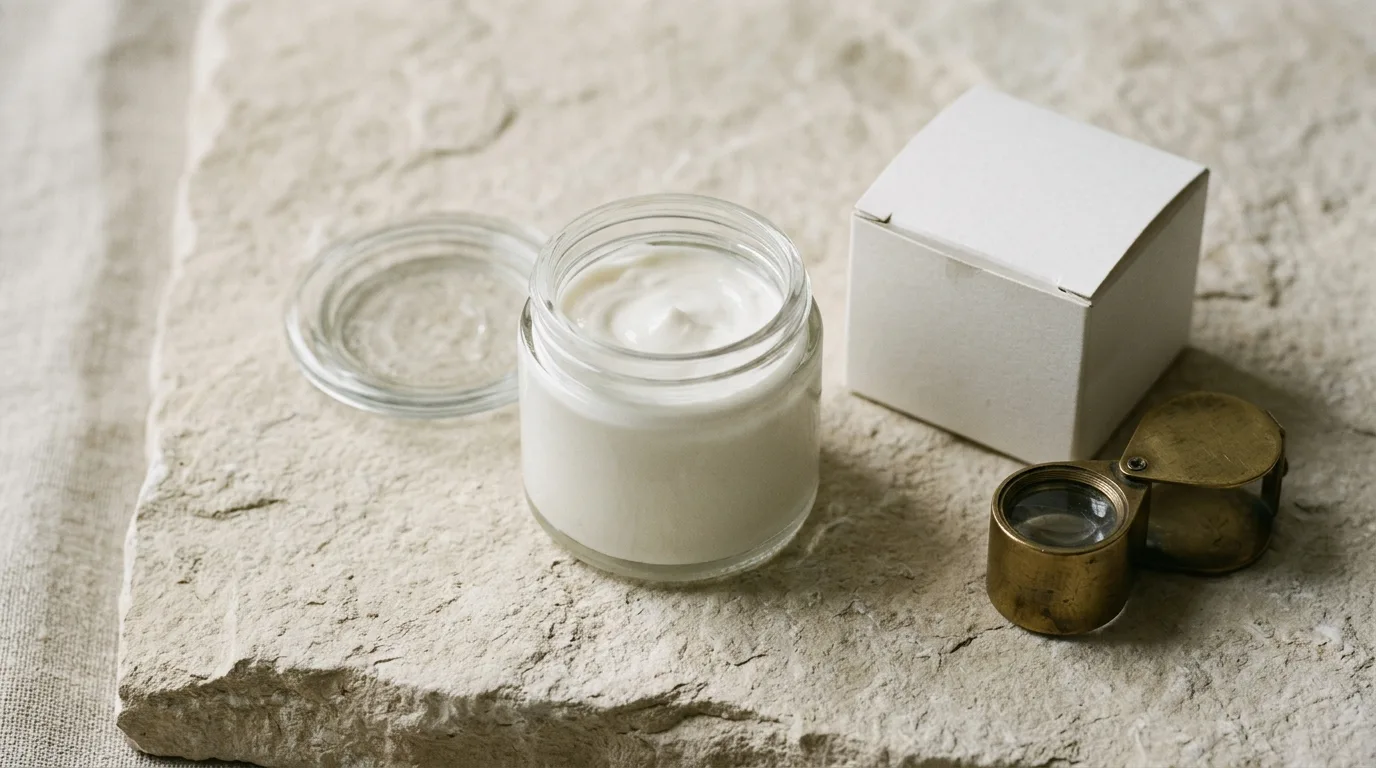
We have nothing to sell you. Six formulations exist, none of them on sale, no ingredient list published, no date in the diary. That makes this a strange moment to write about price, and the only honest one. Once there is a jar with a number on it, everything a house says about cost reads as justification. So here is where the money in a jar of cream goes, ours included, before we have a jar.
Why this can only be written now
A brand explaining its costs while its product sits on a shelf is doing something close to special pleading, even when every number it gives you is true. The explanation arrives attached to an invitation to pay. You can hear the tilt in it. We will not be immune to that later, which is the reason for writing it down while we still have nothing at stake.
The question people actually type is "why is skincare so expensive", and it usually contains two questions wearing one coat. The first is whether the price is arbitrary. The second is whether the expensive one is better. They have different answers, and the honest answer to the second is less satisfying than either side would like.
So: an itemised walk through the stack, in roughly the order the money leaves. Some of these lines are larger than most people expect. One of them is much smaller.
The jar usually costs more than the cream
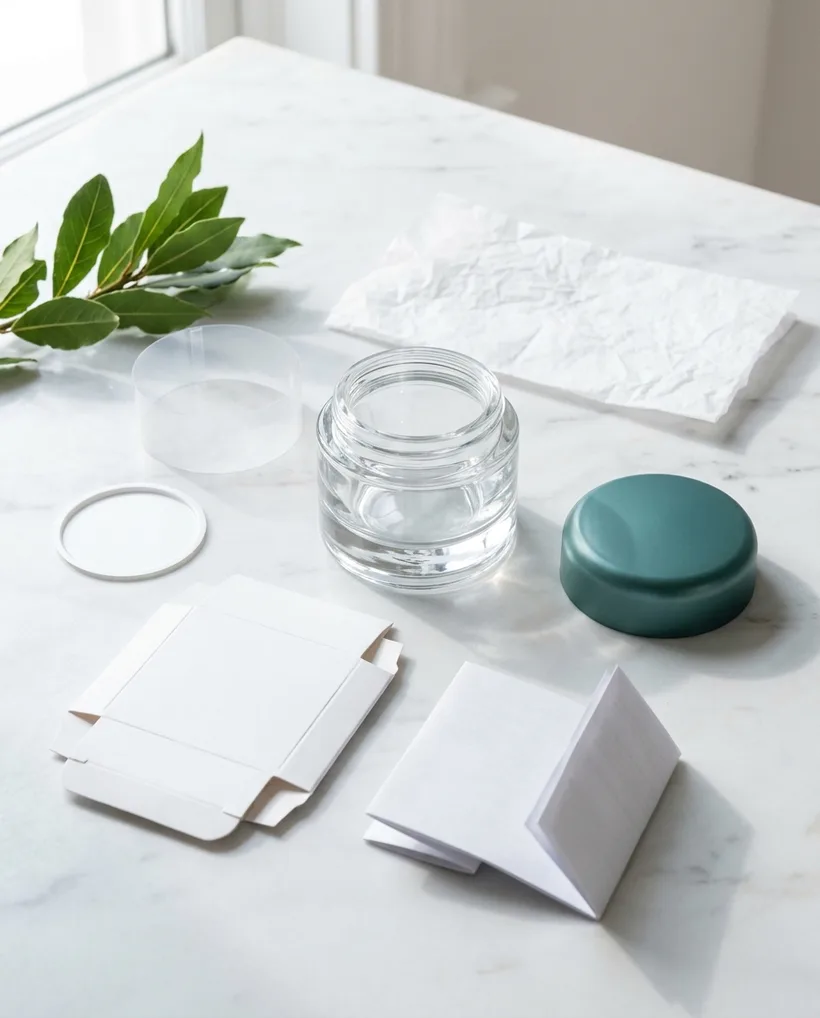
Pick up a jar of moisturiser and weigh it. The heft is deliberate, and it is not free. A thick-walled glass jar, a weighted cap, an inner sealing disc, a shrink band, a folding carton, a leaflet printed in six languages, sometimes a sheet of tissue. Decoration is a separate step again: hot foil, screen printing, embossing, each done on different machinery, often in a different factory, each with its own minimum order.
Some of that weight is theatre. Some of it is doing a job. A formula that oxidises in daylight wants an opaque airless pump, which costs several times what a screw-top jar costs, and the decision is really about how long a formula stays the thing it says it is. The uncomfortable part is that you usually cannot tell which case you are looking at. Heavy glass reads as serious. It is also the cheapest way to make a cheap formula feel expensive.
Then the filling. A run of two thousand units and a run of two hundred thousand need the same line changeover, the same clean-down before and after, the same first-article checks, roughly the same operator hours. Those costs land on the batch, then get divided by the units in it. Small batches carry them badly. Components make it worse: minimum orders mean buying ten thousand caps to fill three thousand jars, and the remainder sits in a warehouse costing rent until it is either used or written off.
All of this happens after the formula is finished. The years of benchwork behind a formulation are their own cost, spent whether the product sells well, badly, or not at all.
Safety and stability, the work nobody sees
The jar usually costs more than the cream. Thick glass, a weighted cap, foil, embossing and a leaflet in six languages are separate purchases from separate factories, each with its own minimum order.
Before a cosmetic can be sold in the EU or the UK it needs a safety assessment signed by a qualified assessor, and a file behind it holding the toxicological profile of every raw material, the exposure calculations, the manufacturing detail. This is not a form you tick. The assessor asks for data, sends things back, and charges for the work. Change a supplier, a preservative or a fragrance component and a good part of it is done again.
Stability testing is slower and stranger. Filled packs go into ovens at several temperatures and sit there for months, alongside freeze-thaw cycles and light exposure, and are pulled at intervals to be checked for pH drift, viscosity, colour, smell, separation. The pack is tested with the formula in it, because glass, plastic and the formula all interact. Preservative systems are checked by deliberately introducing micro-organisms and counting what happens to them over weeks. Real time takes real time. There is no way to buy your way past twelve weeks.
Human tolerance work sits on top of that, and it is worth being precise about what it does and does not establish. The phrase "dermatologically tested" covers an enormous range of effort, from a small supervised patch test to something considerably more thorough, and it promises far less than the confidence with which it is printed. It is a real cost. It is not the same as a claim about what the product does.
The same paperwork, market after market
A product notified in the EU is not thereby notified in the UK, and neither notification helps anywhere else. Each territory wants its own submission, and in most cases a named party legally responsible for the product inside that territory. Labels have to carry the required languages. Any claim printed on the carton needs evidence held on file, per claim, per market.
Our own shops make this concrete in a way we did not fully appreciate at the start. Gibraltar, Andorra and Marbella: one of those three sits inside the EU and two of them do not. One has no VAT at all, another has its own, considerably lower. The same jar moving from one of our shops to another is, on paper, an export, with the customs formalities that implies. Three shops, three sets of rules, one product.
None of this is expensive in the way a machine is expensive. It is expensive in the way that doing the same careful thing four times is expensive: translation, a re-plated carton, another responsible person, another dossier. It falls hardest on small houses and small markets, which is part of why a niche product costs what it does, and part of why some products simply never appear in your country at all.
The Skin Analysis
See your skin as we see it
Free. Sixteen questions, one photograph, and an address to send it to. A written assessment across eight markers, and the protocol that follows from it — no account, no payment, about four minutes.
Begin the free analysisWhat the shop takes
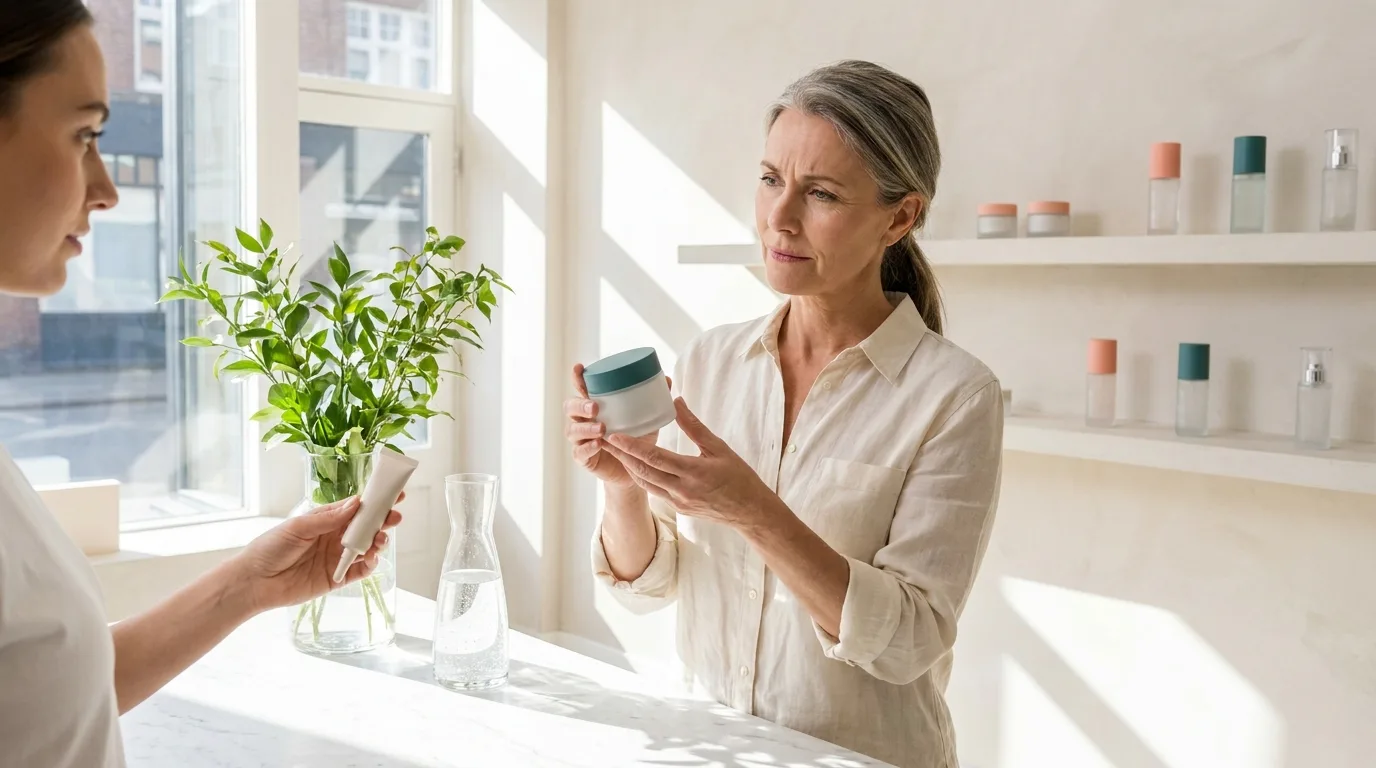
Then distribution, which is where the largest single multiple usually sits. In beauty, the step from what a brand receives to what you pay is commonly around a doubling, and can be more. That is not a scandal on its own. The shop pays rent on a street worth being on, employs and trains people who will stand there all day, holds stock it has paid for, funds the samples in your bag, and takes back what comes back.
Selling direct online moves the money rather than removing it. Acquiring a customer through paid channels can cost as much as a retailer's margin would have. Add payment processing, warehousing, packing for transit, the parcels that arrive broken, and a customer service function that has to exist. Brands that pass their whole retail saving to the customer are rarer than the marketing around direct-to-consumer suggests.
One more line that nobody itemises: discounting. If a house expects a meaningful share of its stock to sell at a promotional price, the full price has to be set high enough to survive that. A product that is permanently on offer has a price designed to be discounted. It is worth noticing which prices in your bathroom are real prices.
The actives are rarely the expensive part
Here is the line that lands badly, and it holds at every price point, including whichever one we end up at. The raw materials are usually the smallest meaningful cost in the jar. Actives are used at fractions of a per cent; even a genuinely costly peptide, bought by the kilogramme, works out to small change per unit. The bulk of the formula is water, humectants, emulsifiers, thickeners, preservative. Priced by weight, that base is cheap.
There are exceptions and they are mostly unglamorous. A generous load of a good oil costs real money. So do low-yield botanical extracts, awkward supply chains, and the plain logistics of moving liquid: bringing mineral water down from a Pyrenean spring to a laboratory in Barcelona costs more than taking it from the mains, for reasons that have nothing to do with romance. Whether that difference is one you could see in a mirror is a separate question, and one we would rather leave open than answer flatteringly.
It follows that cost tells you almost nothing about formulation. Neither, quite, does the label. An ingredient list gives you descending order down to one per cent and then stops being informative, and it says nothing at all about grade, purity, or whether the formula was built around its active or simply had it dropped in near the end. Both signals available to you, price and position on a list, are weaker than they look.
A better question than whether it is worth it
This leaves two comfortable positions, and both are wrong. The first says expensive skincare is a con, the same emulsion in better glass. Sometimes it is. Often somebody did pay for the stability work, the better vessel, a base designed around what it carries rather than around cost per litre. The second says you get what you pay for, which is wrong at least as often, and in a more expensive direction.
Price predicts packaging, distribution and marketing spend fairly well. It predicts formulation quality badly, in both directions. Large manufacturers have volume, in-house laboratories and serious testing budgets, which is exactly why some inexpensive products are properly made. And a high price can be paid entirely to the rent on a good street. Neither fact tells you anything about the jar in your hand.
So the question worth carrying into a shop is not "is this worth it", which cannot be answered without knowing what you value. It is narrower: what specifically am I paying for here. Is the packaging protecting the formula or performing seriousness? Is the claim on the carton narrow enough to be checkable, or broad enough to be unfalsifiable? Is this a real price or a discount waiting to happen?
When we price ours, every force described above will be acting on us, and you should put the same question to us that we have just handed you. Some of what you would be paying for will be work you cannot see and might reasonably value. Some of it will be a shop in Marbella with rent to pay. We would rather you knew which was which.
Sources & References
- Cosmetic products sold in the EU and the UK must have a safety assessment completed by a qualified assessor, and a product information file held for them, before they go on sale. This is a matter of public regulation rather than industry custom. Article 10 (Safety assessment), Regulation (EC) No 1223/2009 on cosmetic products
- Ingredient lists are given in descending order of concentration down to one per cent, below which ingredients may be listed in any order. This is a long-standing labelling convention, not a research finding. Annex I (Cosmetic Product Safety Report), Regulation (EC) No 1223/2009 on cosmetic products
- Preservative systems are generally checked by deliberately introducing micro-organisms into a finished formula and measuring how the population falls over a period of weeks. The approach is standard across the industry.
- It is generally understood within the cosmetics trade that raw materials account for a small share of a finished product's retail price, and that most cosmetic actives are used at fractions of a per cent of a formula.
Related Reading



Explore Zero Lines
Maximise overnight repair with the Renewal and Repair Night Cream, formulated specifically to support your skin's circadian regeneration cycle.