
You can usually tell a sleep line by its manners. It is there in the mirror at seven, softer by nine, gone by lunch — until the year it isn't. The question that brings most people to this page is whether a silk pillowcase prevents the whole business. The short answer is that silk helps a little, considerably less than it is sold as helping, and that there is something better you probably won't do.
A different kind of crease
An expression line has a cause you can watch happen. Squint into the sun and the muscle around your eye contracts, and the skin above it folds because it has no choice. Do that a few hundred thousand times across a few decades, while the skin's capacity to spring back quietly declines, and the fold stops fully unfolding. That is the entire mechanism. It is also why expression lines sit at right angles to the muscle that makes them — they are the pleat left by a movement.
A sleep line is made by the opposite thing: nothing moving at all. Your face rests against a surface for six or seven hours. The skin underneath is compressed, pushed slightly sideways by the drag of the fabric, and then held there. No contraction is involved. The line is the shape of the pillow's resistance rather than the shape of a feeling.
You can often tell the two apart by direction. Expression lines run across the muscle that folds them. Sleep lines ignore the muscles entirely — a vertical crease down one cheek, two or three short diagonals on one side of the forehead, a fan under one eye running the wrong way. When a line does not correspond to any face you have ever pulled, that is the clue. Whether it is still only a surface crease or has become something that stays is a separate question, and the difference between a line that fades by mid-morning and one that has settled is worth understanding on its own terms.
Why it shows on one side
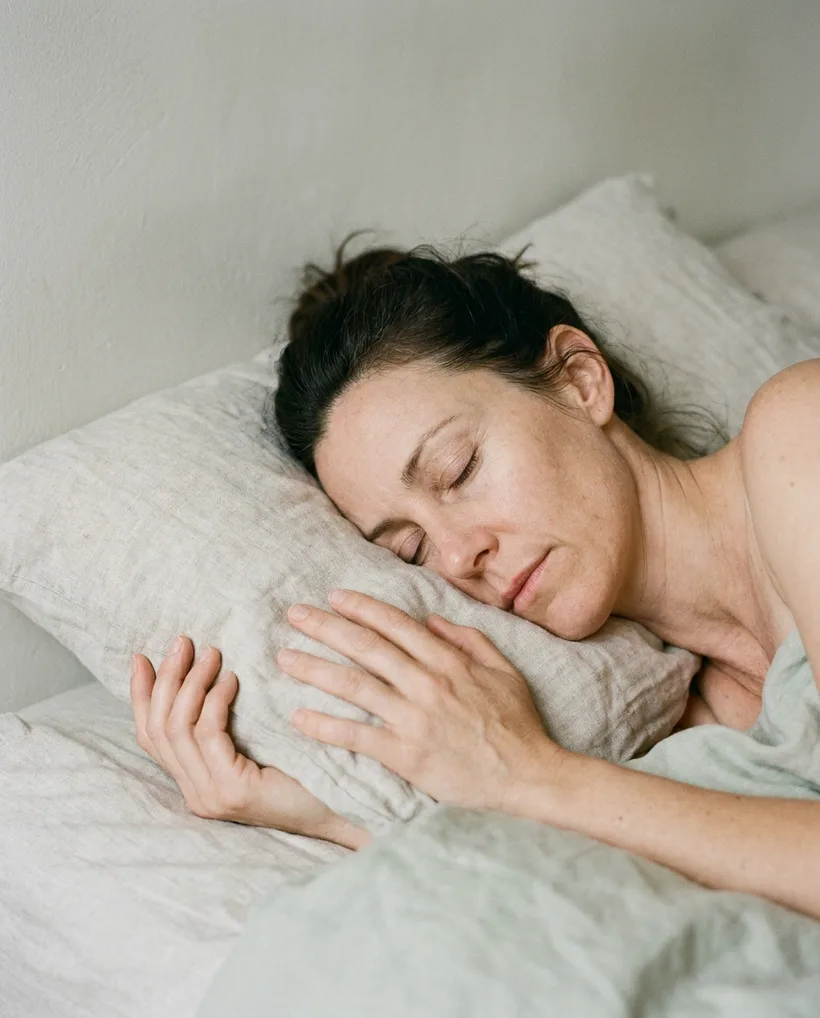
Almost everyone has a side. Ask someone which way they turn when they fall asleep and they usually know without having to think about it. Over years that preference writes itself asymmetrically: one cheek carries a crease the other doesn't, one nasolabial fold looks a shade deeper, one eye area looks slightly more crumpled at seven in the morning and takes longer to settle.
The asymmetry is the tell. Sun exposure across a face is broadly even, with the well-known exception of people who have driven the same route for thirty years, where the window side shows it. Expression is broadly even too; nobody smiles with half their face. So when one side looks consistently more marked than the other, in the same places, sleeping position is the ordinary explanation and usually the right one.
It is not only the face. The chest takes it as well — the vertical lines that appear down the décolletage in long-term side sleepers come from the same mechanism, skin folded and held for hours on skin that is thinner there to begin with. The neck creases along the same logic. These are the areas that get a fraction of the attention the face does, which is a shame, because they tend to show time earlier and more plainly.
What the pillowcase is actually doing
A sleep line is made by nothing moving at all. Skin is compressed against a surface for six or seven hours and held there, which is the opposite of how an expression line forms.
Cotton is spun from short fibres. However fine the weave, the surface at close range is a field of fibre ends, and when your head turns in the night the skin is dragged very slightly across all of them. Silk is a continuous filament, so the surface is smoother and the drag is less. That part is not marketing but textile mechanics, and it is the same reason silk is easier on hair.
The second difference is thirst. Cotton is absorbent by design — it is what makes it good for towels — and some of what it takes up over a night comes from your skin and from whatever you put on your skin before bed. Silk absorbs less. The film of moisture you applied at eleven is more likely to still be doing its job at three. Skin that holds its water looks plumper, and plumper skin takes a crease less readily and gives it up faster in the morning.
Two practicalities, since the market is noisy. Momme weight is the useful number on a silk pillowcase, and the high teens to low twenties is the sensible range; lighter tears, heavier is warm and expensive. And whatever the fibre, wash it often — a pillowcase gives back to your face whatever was left on it the night before.
What silk changes and what it doesn't
There are two forces acting on your cheek overnight and they are not equal. One is friction, the sideways drag as you turn. The other is compression, the weight of your head pressing skin into a fold and keeping it there. Silk addresses the first. It does nothing whatsoever about the second, and the second is the larger of the two. The crease you see at breakfast is mostly a fold that was held, not a surface that was rubbed.
So the benefit is real and it is modest. Less drag on skin and hair, a little less moisture pulled away, a face that looks marginally less pressed first thing. If a silk pillowcase costs what a decent bottle of wine costs and it makes the mornings slightly kinder, that is a perfectly good purchase. The hair benefit is the more obvious of the two and is arguably the better reason to own one.
What nobody can honestly tell you is what a pillowcase does to a face over ten years. The claim you see is prevents wrinkles. The accurate version is reduces one of the two forces behind one category of line, by an amount nobody has established. Those are not the same sentence, and the second does not sell as well. The evidence here is thinner than the confidence around it, which is the usual state of affairs.
The Skin Analysis
See your skin as we see it
Free. Sixteen questions, one photograph, and an address to send it to. A written assessment across eight markers, and the protocol that follows from it — no account, no payment, about four minutes.
Begin the free analysis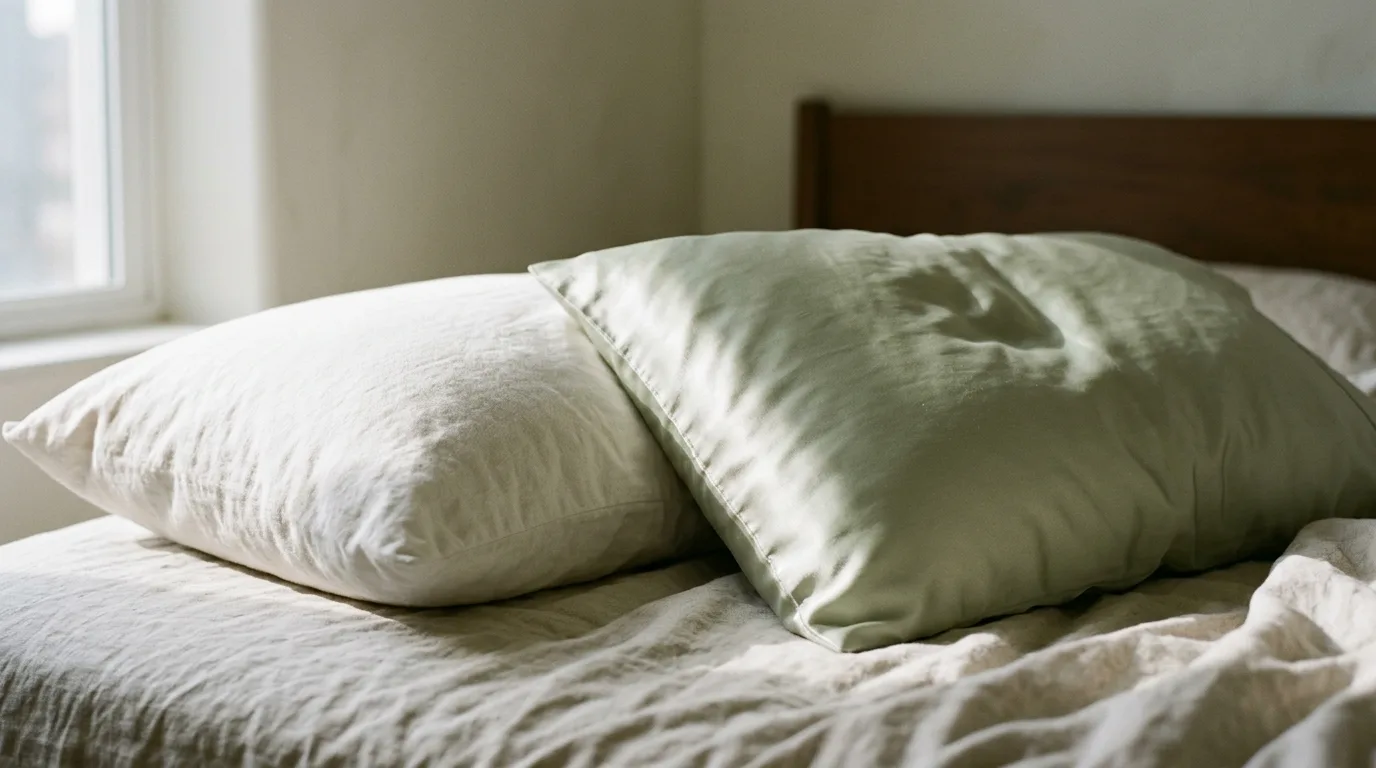
Back sleeping is better and much harder
The intervention that actually addresses compression is not a fabric at all. It is not putting your face on the pillow. Sleep on your back and the sleep line has nothing to form against; the skin is loaded evenly by gravity rather than folded against a surface. This is the honest answer, and it is the one nobody sells, because there is nothing to sell.
It is also very hard to do. People change position many times a night, and you cannot supervise yourself while unconscious. You can fall asleep flat on your back with excellent intentions and be face-down in the pillow by two in the morning. Most people who set out to change their sleeping position manage a partial change at best.
Partial still counts, which is the encouraging part. Three hours on your back is three hours without compression. What helps: a pillow tucked under each arm so that rolling is less inviting, a pillow height that supports the neck without encouraging the head to turn, and the old trick borrowed from snoring advice of sewing something uncomfortable into the back of a sleep shirt. None of it is elegant. Some of it works.
One caution. Lying flat does not suit everyone — reflux, breathing problems in sleep and later pregnancy all change the arithmetic, and those are conversations for a doctor rather than for a skincare journal. If sleeping on your back makes you sleep badly, the trade is a poor one. The repair work that happens across a good night is worth more to a face than any fabric under it.
The rest of the night matters more than the fabric
Which is the part worth sitting with. How well those hours go does more for how a face looks in the morning than the thread it rested on. A rested face with a sleep crease across it looks better than an exhausted one on silk.
Alcohol is the clearest example. Two glasses at ten will get you to sleep faster and give you a worse night, fragmented in the second half when the deeper work happens, and the effect a couple of drinks has on the morning face is not subtle: fluid sits where it shouldn't, and a swollen cheek takes a crease more readily and holds it longer.
Stress works at both ends. It makes sleep shallower and it keeps the body in a state it was meant to visit only briefly, and the connection between long-running stress and how skin looks over time is among the better-established links in this whole field. If you are waking at four with your jaw clenched, the pillowcase is not the variable to change.
What we would actually say
In order: position first, if you can manage any of it. Fabric second, because it is cheap and pleasant and does something small. Sleep quality underneath both, because it is worth more than either. And then a reasonable expectation, which is that a sleep line responds to all of this partially and slowly, and that a crease fifteen years in the making does not leave because you bought a pillowcase in March.
We are in an odd position to be writing this. We have six formulations in development in a laboratory in Barcelona and not one of them is for sale, so there is nothing at the end of this paragraph to buy. Which makes it easier to say the true thing: nothing in a jar undoes a fold held for six hours a night for a decade. Well-moisturised skin looks smoother and takes a crease less deeply, and that is genuine and worth having, but it is a smaller thing than the language around it suggests.
Buy the silk pillowcase. It is a mild good, and mild goods add up. Just know which lever you are pulling — it is the smallest one in the room, and the largest one is free.
Sources & References
- Dermatology has long described sleep-related facial lines as a category of their own, told apart from expression lines by an orientation that does not follow the muscle beneath. Sleep Wrinkles: Facial Aging and Facial Distortion During Sleep (Anson G, Kane MA, Lambros V, Aesthet Surg J. 2016;36(
- It is generally understood that skin's elastic recoil declines with age, which is why a fold held for several hours releases more slowly at fifty than it does at twenty. Sleep positions and position shifts in five age groups: an ontogenetic picture (De Koninck J, Lorrain D, Gagnon P, Sle
- Basic textile science: silk is a long continuous filament and produces less surface friction than short-staple cotton, which is also the more absorbent of the two fibres.
- Sleep researchers generally observe that people change position repeatedly through the night, and that deliberately holding a chosen position once asleep is difficult to sustain.
Related Reading

Explore Zero Lines
Maximise overnight repair with the Renewal and Repair Night Cream, formulated specifically to support your skin's circadian regeneration cycle.