
A stone drawn across a cheekbone in the morning does something. You can see it in the mirror ten minutes later, and you are not imagining it. The question is what that something is, and the honest answer is smaller and more interesting than the one usually offered. It is fluid. Not lift, not tone, not muscle. Fluid, moved a few centimetres, and it will find its way back.
What is actually happening under the skin
Skin sits on a layer of tissue that holds interstitial fluid — water that lives outside the cells, in the spaces between them. It is not static. It drains away through lymphatic vessels, and those vessels have no pump of their own. They depend entirely on things outside themselves: muscle movement, the rhythm of breathing, gravity, and pressure applied from the surface.
Which is the whole reason massage does anything at all. Slow, gentle pressure directed towards the neck creates a gradient, and fluid moves along it. The effect is not dramatic. But on a face that has spent eight hours horizontal, shifting a small volume out of the hollows under the eyes and along the line of the jaw changes the outline of that face in a way you can see from across a bathroom.
It looks tighter. It is not tighter. It is less full. That distinction is the entire honest content of this practice, and everything else built on top of it is decoration.
Why a face is at its fullest at seven in the morning
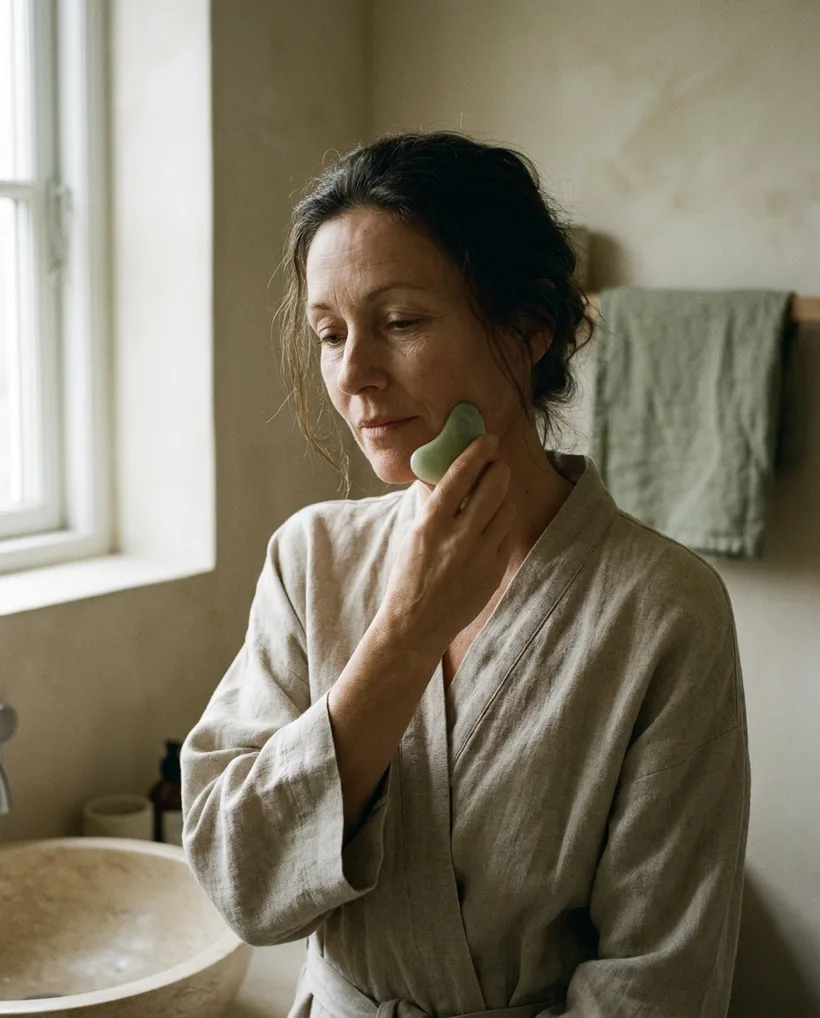
Lie down and gravity stops pulling fluid towards your feet. Over a night it redistributes, and the face takes a disproportionate share of it — the eyelids especially, where the skin is thin and loosely attached and has very little to hold it in place. Stand up and the body begins undoing this without any assistance. For most people, an hour or two upright does most of the work.
Some mornings are worse than others, and the reasons are usually boring. Salt at dinner. A long flight. Sleeping face-down in a pillow. A second glass of wine the night before reliably produces a fuller, softer-looking face by morning, which is one of the more visible short-term effects anyone can observe on themselves. Short sleep does its own separate thing, and what the skin gets up to overnight is worth understanding on its own terms rather than as a puffiness problem.
One thing to set aside before going further. Swelling that is one-sided, painful, persistent, or genuinely new without an obvious cause is not a question about facial massage. It is a question for a doctor, and it should be asked as one. What follows is about ordinary morning fullness in an otherwise well face.
Real, immediate, and gone by evening
What moves is interstitial fluid. Lymphatic vessels have no pump of their own and depend on muscle movement, breathing, gravity and pressure from the surface — which is the whole reason massage does anything at all.
The effect of five minutes with a stone is real. You can photograph it. It is also short — hours, not days. The fluid you moved returns as the body's ordinary balance reasserts itself, and by evening the face you have is the face you would have had anyway.
This is the point where the claims get strange. Because the immediate result is so visible, it gets quietly extrapolated into a cumulative one: do this every morning for six weeks and the shape of your face will change. There is no good reason to believe that. What you get on day forty-two is the same morning-to-afternoon effect you got on day one, arriving on schedule and leaving on schedule.
Which is not nothing. Looking more like yourself before a meeting that matters is a perfectly good thing to want, and a method that reliably delivers it for a few hours is worth having. It just isn't an intervention, and calling it one does the practice no favours.
What it does not do
It does not lift. Lifting means moving structures — fat pads, the retaining ligaments that tether skin to the underlying bone, the position of tissue relative to that bone. These change slowly with age as ligaments loosen and volume redistributes downwards. A piece of polished stone held in the hand for five minutes does not move them, and no amount of technique changes that arithmetic.
It does not build collagen. The claim leans on a mechanism that sounds credible, because it partly is: fibroblasts do respond to mechanical stress. But the honest limit of this is that the forces used in professional wound and scar work are sustained over weeks and applied at intensities nothing like a morning routine, and nobody has shown that a hand tool moved across a cheek produces anything comparable. The evidence here is a great deal thinner than the confidence around it.
And it does not do much about lines. It helps to be precise about which kind, because a line that appears only when you smile is a different thing from one that stays put when your face is still. Massage does not meaningfully change either. A puffy face can make lines look softer for an hour by filling them slightly from beneath, which is the opposite of the mechanism people imagine.
The Skin Analysis
See your skin as we see it
Free. Sixteen questions, one photograph, and an address to send it to. A written assessment across eight markers, and the protocol that follows from it — no account, no payment, about four minutes.
Begin the free analysisFace yoga and the expression problem
Face yoga proposes that the muscles of the face can be trained like any other muscle. The premise is not absurd on its face — these are muscles, and muscles adapt to load. The difficulty is in where they attach. Most facial muscles insert into the skin itself rather than running bone to bone, and their job is expression, not moving weight. What "stronger" would even mean for a muscle whose purpose is to pull skin into a shape is not obvious, and the people selling the programmes rarely say.
Then there is the awkward part. The mechanism most widely accepted for expression lines is the repeated folding of skin along the same creases, over decades, in a dermis that becomes slower to spring back. A regime built on deliberately making large, exaggerated expressions several times a day sits uneasily next to that. It may well be neutral. It may be very slightly counterproductive. Nobody has shown either, and that uncertainty is itself the useful information: a practice sold as anti-ageing has no demonstrated advantage over doing nothing at all, alongside a plausible if unproven cost.
If you find it relaxing, if the jaw and neck work eases tension you carry there, that is a real benefit and a sufficient reason to continue. Take it as movement, not as a face-shaping programme.
The stone is not the active ingredient
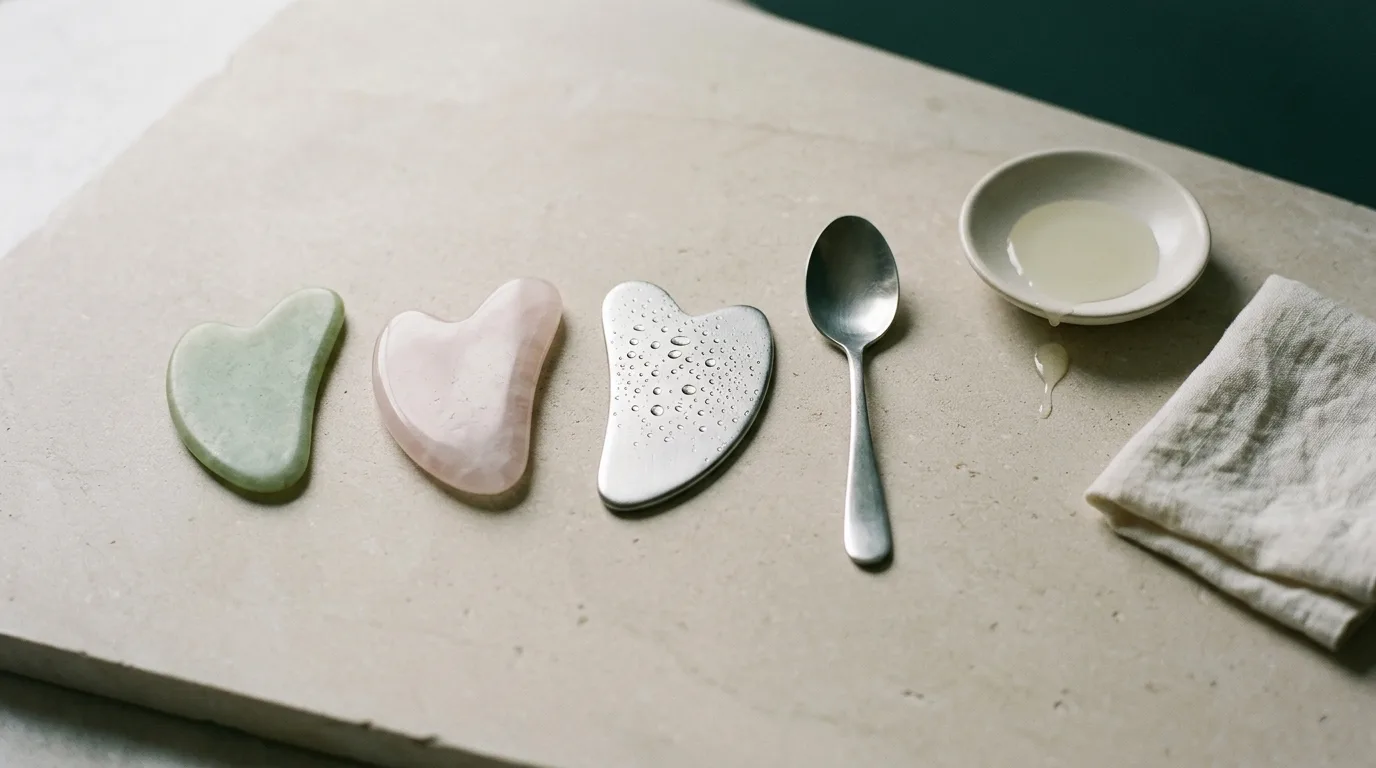
Jade, rose quartz, bian stone, stainless steel, the back of a cold spoon. A good deal of meaning gets attached to the material, and whatever you make of that, the mechanical reality is that the shape and the pressure do the work. A curved edge that follows the jaw, held at a shallow angle, moved slowly, in one direction. That is the technique. The mineralogy is not participating.
The one physical property that genuinely contributes is temperature. Cold briefly narrows the superficial blood vessels, and that accounts for a fair share of the tightened look people attribute to the stone itself. A cheap steel tool kept in the fridge does this better than an expensive stone at room temperature, which tells you something about where the money goes.
What actually matters most is the slip. Dragging any tool across dry skin is how people give themselves friction rash and broken capillaries, and it is the single most common way this goes wrong. You want enough facial oil or a rich balm that the tool glides with no tug anywhere, including the awkward bit under the cheekbone. The oil is doing more for your face than the jade is. Around the eyes the pressure should be barely present at all — that skin is the thinnest on the body and the most likely to be handled roughly by someone chasing puffiness — and whether that area needs a product of its own is a separate question worth answering honestly.
Keeping it in proportion
Here is the position we would defend. Gua sha is a pleasant five minutes that makes a face look less swollen for part of a day, using a real mechanism, at a real but modest scale. It is also genuinely calming, and the way a face looks after months of unrelieved stress is not unconnected to what stress does over time. A few quiet minutes before the day starts is not a trivial thing to have found.
What we would rather not see is anyone being told that a stone competes with sun protection, or sleep, or the simple passage of time. The inflation around these tools is out of all proportion to what they do, and the odd result of that inflation is that people try them, notice the effect fade by lunchtime, and conclude they were sold nothing. They were not sold nothing. They were sold something small, described as something large.
Do it because your face feels better afterwards and because the five minutes are yours. That is a sufficient reason. It does not also need to be a treatment.
Sources & References
- It is generally understood in basic physiology that body fluid redistributes with posture — lying down shifts it towards the head and face, and standing reverses that over the following hour or two. This is uncontroversial and observable on yourself. Effect of Trendelenburg position and lower-body positive pressure on neck fluid distribution
- The lymphatic system is generally understood to have no central pump. Fluid moves through it by way of surrounding muscle contraction, breathing, and pressure applied from outside, which is the principle behind manual drainage techniques used in clinical care after surgery. Botulinum Toxin Injection for Facial Wrinkles
- Expression lines are generally attributed to the repeated folding of skin along the same creases over many years, in combination with the gradual decline of collagen and elastin that makes those folds slower to recover. Mechanisms and modifiers of reflex induced cutaneous vasodilation and vasoconstriction in humans
- Cold is generally understood to constrict superficial blood vessels for a short period, which is why a chilled tool, a cold flannel, or cold water briefly changes how a face looks.
Related Reading



Explore Zero Lines
Maximise overnight repair with the Renewal and Repair Night Cream, formulated specifically to support your skin's circadian regeneration cycle.